
Comparative Evaluation of Activated Sludge, Biogrow Biofilm, and Hybrid Systems for the Removal of Pollutans from Shrimp Pond Wastewater
Article Sidebar
-
Activated Sludge, Biogrow, Combination, Shrimp Pond, Wastewater Treatment
Abstract
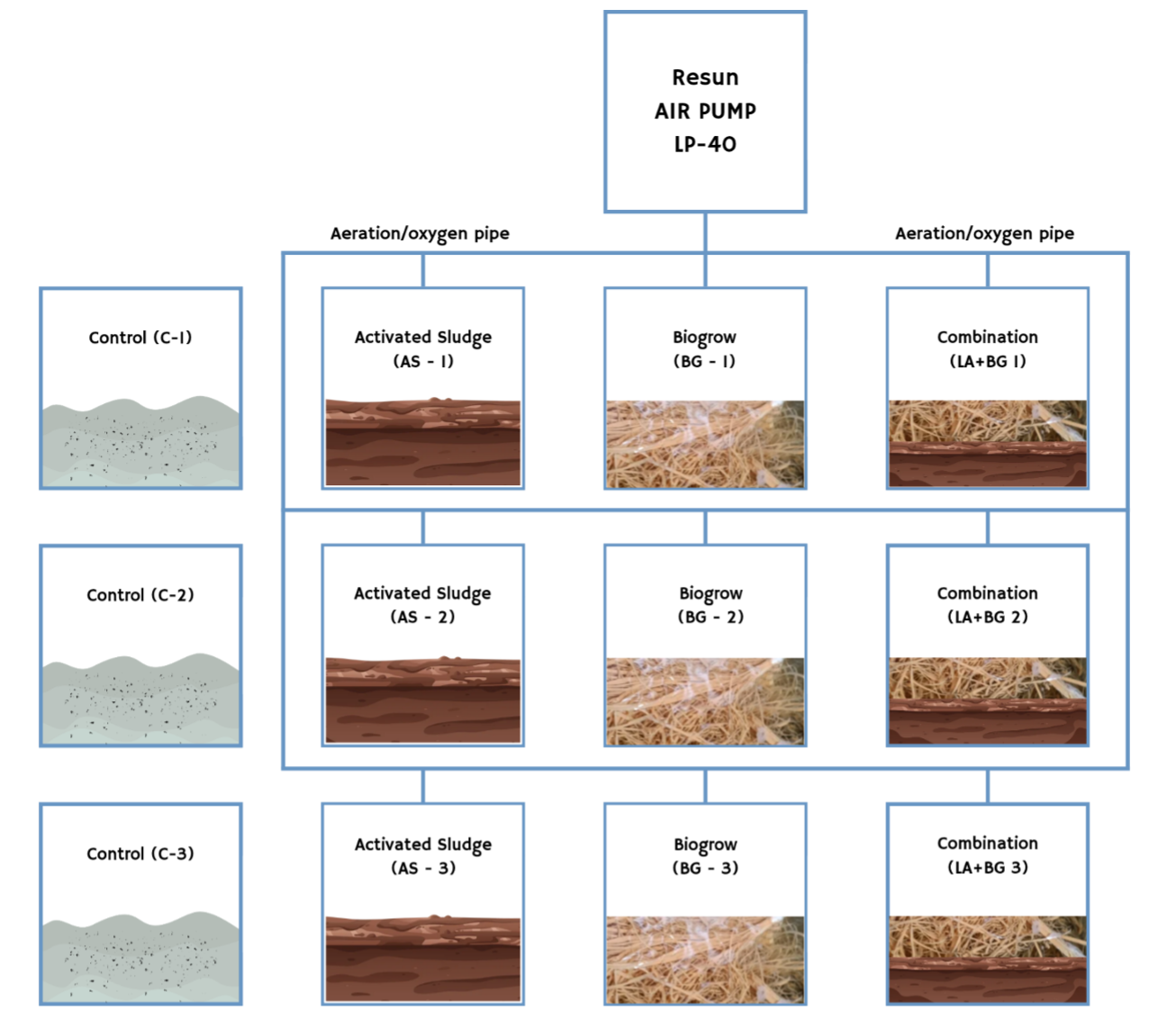
Litopenaeus vannamei shrimp farming is a segment of aquaculture with significant economic potential. However, the wastewater produced during this process contains various pollutants, including salinity, phosphate, hydrogen sulfide, ammonia, nitrate, and nitrite. If it is discharged untreated, these pollutants can contribute to environmental pollution. This study aimed to compare the effectiveness of activated sludge, Biogrow, and a combination of both systems in reducing pollutant concentrations in shrimp pond wastewater. The experiment was conducted over 8 days in a batch system using Greenbio 1103 bacterial resin. Physical and chemical characteristics of the wastewater were analyzed on days 0, 2, 4, 6, and 8. Data were analyzed using Two-Way ANOVA, followed by Tukey’s post-hoc test. The results indicated a significant interaction (p < 0.05) between treatment duration and treatment media in reducing ammonia, COD, phosphate, and TSS concentrations. Among the systems tested, the Biogrow medium exhibited the highest treatment efficiency, achieving removal rates of 99.5% for ammonia (from 15.18 to 0.079 mg/L), 57.1% for COD (from 1402.9 to 601.7 mg/L), 93.8% for phosphate (from 1.27 to 0.079 mg/L), and 42.9% for TSS (from 980 to 560 mg/L). In comparison, activated sludge alone achieved lower removal rates: 87.2% for ammonia, 45.4% for COD, 91.9% for phosphate, and 24.5% for TSS. The enhanced performance of Biogrow was attributed to its large specific surface area, which facilitated bacterial attachment and supported the development of a stable biofilm structure.
References
Adhar, S., Lukman, M. Khalil, E. Ayuzar, Erlangga, R. Rusydi, Mainisa, and Muliani (2022). Influence of Rainfall and Spatial Temporal Distribution Analysis of Total Suspended Solid in Laut Tawar Lake. IOP Conference Series: Earth and Environmental Science, 1062(1); 012022
Adonadaga, M.-G. (2014). Nutrient Removal Efficiency of Activated Sludge Plants Treating Industrial and Municipal Wastewater in Ghana. Journal of Environment Pollution and Human Health, 2(3); 58–62
Akinnawo, S. O. (2023). Eutrophication: Causes, Consequences, Physical, Chemical and Biological Techniques for Mitigation Strategies. Environmental Challenges, 12; 100733
Aktur, S. and N. Yeumine (2020). Vannamei Shrimp Cultivation Including Distribution, Feed Quality and Feeding Method. Journal Siplieria Sciences, 1(2); 1–5
Anwar, C., A. N. Confera, A. S. Noerwahju, W. Handayani, and Y. A. Handoko (2023). The Evaluation of Physical, Biological, and Chemical Treatments on Piggery Wastewater: A study on pig farming in Sumogawe village, Semarang Regency, Central Java. IOP Conference Series: Earth and Environmental Science, 1275(1); 012032
Arabgol, R., P. A. Vanrolleghem, and R. Delatolla (2022). Influence of MBBR Carrier Geometrical Properties and Biofilm Thickness Restraint on Biofilm Properties, Effluent Particle Size Distribution, Settling Velocity Distribution, and Settling Behaviour. Journal of Environmental Sciences, 122; 138–149
Atikah, S. K., R. Kurniawan, and M. S. Hasibuan (2023). Litopenaeus Vannamei Shrimp Pond Water Temperature and pH Monitoring System Using IoT-Based Sugeno Fuzzy Method. Jurnal Info Sains: Informatika dan Sains, 13(02); 393–398
Bai, D., X. Li, Z. Liu, L. Wan, C. Song, Y. Zhou, and X. Cao (2023). Nitrogen and Phosphorus Turnover and Coupling in Ponds with Different Aquaculture Species. Aquaculture, 563; 738997
Biesterfeld, S., G. Farmer, P. Russell, and L. Figueroa (2003). Effect of Alkalinity Type and Concentration on Nitrifying Biofilm Activity. Water Environment Research, 75(3); 196–204
Boavida-Dias, R., J. R. Silva, A. D. Santos, R. C. Martins, L. M. Castro, and R. M. Quinta-Ferreira (2022). A Comparison of Biosolids Production and System Efficiency between Activated Sludge, Moving Bed Biofilm Reactor, and Sequencing Batch Moving Bed Biofilm Reactor in the Dairy Wastewater Treatment. Sustainability, 14(5); 2702
Cao, Z., W. Yan, M. Ding, and Y. Yuan (2022). Construction of Microbial Consortia for Microbial Degradation of Complex Compounds. Frontiers in Bioengineering and Biotechnology, 10; 1051233
Chinnaraj, S., M. Jothilingam, and S. Jeganathan (2014). An Evaluation of Biofilm Membrane Bioreactor (Bf-MBR). IOSR Journal of Mechanical and Civil Engineering, 11(2); 05–11
Derakhshan, A., R. Rezaei Kalantari, M. Farzadkia, A. Tiyuri, and A. Esrafili (2023). The Effect of Biological Treatment Methods on the Concentration of Carbonaceous Pollutants in the Slaughterhouse Wastewater: A Systematic Review. Case Studies in Chemical and Environmental Engineering, 8; 100451
Iber, B. T. and N. A. Kasan (2021). Recent Advances in Shrimp Aquaculture Wastewater Management. Heliyon, 7(11); e08283
Li, D., Z. Wang, Y. Yang, H. Liu, S. Fang, and S. Liu (2023). Research Status and Development Trend of Wastewater Treatment Technology and Its Low Carbonization. Applied Sciences, 13(3); 1400
Li, J., W. Zhu, H. Dong, Z. Yang, P. Zhang, and Z. Qiang (2020). Impact of Carrier on Ammonia and Organics Removal from Zero-Discharge Marine Recirculating Aquaculture System with Sequencing Batch Biofilm Reactor (SBBR). Environmental Science and Pollution Research, 27(28); 34614–34623
Lu, J., Y. Hong, Y. Wei, J.-D. Gu, J. Wu, Y. Wang, F. Ye, and J.-G. Lin (2021). Nitrification Mainly Driven by Ammonia-Oxidizing Bacteria and Nitrite-Oxidizing Bacteria in an Anammox-Inoculated Wastewater Treatment System. AMB Express, 11(1); 158
Masatlis, I., A. Chatzis, and A. Zouboulis (2025). Biofilm Control in Wastewater Treatment: A Review Regarding the Application of Quorum Sensing and Quenching Processes and Future Perspectives. Water, 18(1); 77
Melo, A., C. Quintelas, E. C. Ferreira, and D. P. Mesquita (2022). The Role of Extracellular Polymeric Substances in Micropollutant Removal. Frontiers in Chemical Engineering, 4; 778469
Mubarok, A. K. U. and M. Zainuri (2024). Efektifitas Rumput Laut (Gracilaria sp.) Terhadap Penurunan Nilai Kandungan Amonia dari Air Limbah Tambak Udang di Socah Madura. Juvenil: Jurnal Ilmiah Kelautan dan Perikanan, 5(1); 96–103. (in indonesia)
Munandar, A., K. Nabila, and R. N. Azizah (2023). Chemical Oxygen Demand (COD) and Total Suspended Solid (TSS) Removal from Rubber Wastewater Factory Using Electrocoagulation Technique. Indonesian Journal of Environmental Management and Sustainability, 7(1); 27–31
Muqsith, A. (2014). Dampak Kegiatan Tambak Udang Intensif Terhadap Kualitas Fisik-Kimia Perairan Banyuputih Kabupaten Situbondo. Samakia: Jurnal Ilmu Perikanan, 5(1). (in indonesia)
Musifa, E., N. R. Palapa, and B. R. Ahadito (2025). Microalgae-Based Wastewater Treatment as Green Solution for Sustainable Degradation and Its Challenges: A Review. Indonesian Journal of Environmental Management and Sustainability, 9(4); 171–182
Nemati, B., M. M. Baneshi, H. Akbari, R. Dehghani, and G. Mostafaii (2024). Phytoremediation of Pollutants in Oil-Contaminated Soils by Alhagi camelorum: Evaluation and Modeling. Scientific Reports, 14(1); 5502
Pold, G., A. Saghaï, C. M. Jones, and S. Hallin (2025). Denitrification Is a Community Trait with Partial Pathways Dominating across Microbial Genomes and Biomes. Nature Communications, 16(1); 9495
Qi, W. and J. Vielma (2026). Effects of Alkalinity-Controlling Chemicals on Biofilter Performance and Sludge Properties in Freshwater Recirculating Aquaculture Systems. Aquacultural Engineering, 114; 102726
Saini, S., S. Tewari, J. Dwivedi, and V. Sharma (2023). Biofilm-Mediated Wastewater Treatment: A Comprehensive Review. Materials Advances, 4(6); 1415–1443
Sanjaya, E. H., A. A. Asha, Suharti, Muntholib, and H. Chen (2025). Effectiveness of Aerobic Microbes in the Treatment of Shrimp Pond Wastewater. Malaysian Journal of Chemistry, 27(1); 211–219
Sharma, M., S. Agarwal, R. Agarwal Malik, G. Kumar, D. B. Pal, M. Mandal, A. Sarkar, F. Bantun, S. Haque, P. Singh, N. Srivastava, and V. K. Gupta (2023). Recent Advances in Microbial Engineering Approaches for Wastewater Treatment: A Review. Bioengineered, 14(1); 2184518
Soares, H. S. A., F. Rocha Pinto, D. B. d. Alencar, and M. H. R. Nascimento (2019). pH Analysis of a Wastewater Treatment Plant (WWTP) in a Paper Recycling Industry. International Journal for Innovation Education and Research, 7(11); 1062–1069
Syukor, A. R. A., S. Sulaiman, J. P. Chandrakant, P. Mishra, M. Nasrullah, L. Singh, and A. W. Zularism (2021). Energy Generation from Fish-Processing Waste Using Microbial Fuel Cells. In Delivering Low-Carbon Biofuels with Bioproduct Recovery. Elsevier, pages 101–121
Telaumbanua, B. H., N. P. L. Pangemanan, R. A. Tumbol, S. L. Undap, S. S. Tumembouw, and I. R. N. Salindeho (2024). Fluktuasi Parameter Kualitas Air di Tambak Super Intensif Udang Vaname: Studi Kasus Pertambakan PT. Pillar Persada Parigi, Desa Bajo, Minahasa Selatan. Budidaya Perairan, 12(2); 72–79. (in indonesia)
Tuo, Z., L. Bai, B. Zhang, S. Jing, C. Li, and S. Tang (2024). Characteristics of Nitrogen Removal from an Integrated Fixed-Film Activated Sludge (IFAS) System and the Relationship Between Activated Sludge and Biofilm Interactions. Water, 16(21); 3040
Ugbenyen, A., N. Vine, J. Simonis, A. Basson, and A. Okoh (2015). Characterization of a Bioflocculant Produced from the Consortium of Three Marine Bacteria of the Genera Cobetia and Bacillus and Its Application for Wastewater Treatment. Journal of Water, Sanitation and Hygiene for Development, 5(1); 81–88
Unuofin, J. O., A. I. Okoh, and U. U. Nwodo (2019). Aptitude of Oxidative Enzymes for Treatment of Wastewater Pollutants: A Laccase Perspective. Molecules, 24(11); 2064
Urbini, G., R. Gavasci, and P. Viotti (2015). Oxygen Control and Improved Denitrification Efficiency by Means of a Post-Anoxic Reactor. Sustainability, 7(2); 1201–1212
Wang, J., Y. Qian, and J. Lv (2026). Coupled Electrocoagulation-Integrated Fixed-Film Activated Sludge Process for Treatment of Low C/N Ratio Aquaculture Wastewater. Environmental Technology & Innovation, 42; 104913
Zhang, B., D. Ning, Y. Yang, J. D. Van Nostrand, J. Zhou, and X. Wen (2020). Biodegradability of Wastewater Determines Microbial Assembly Mechanisms in Full-Scale Wastewater Treatment Plants. Water Research, 169; 115276