
Beyond Linear Regression: A Non-Linear Hygroscopic Growth Correction for Satellite-Derived PM2.5 Estimation in Tropical Environments
Article Sidebar
-
PM2.5 Estimation, Aerosol Optical Depth, Hygroscopic Growth, Tropical Atmosphere, CAMS Reanalysis, Satellite Remote Sensing
Abstract
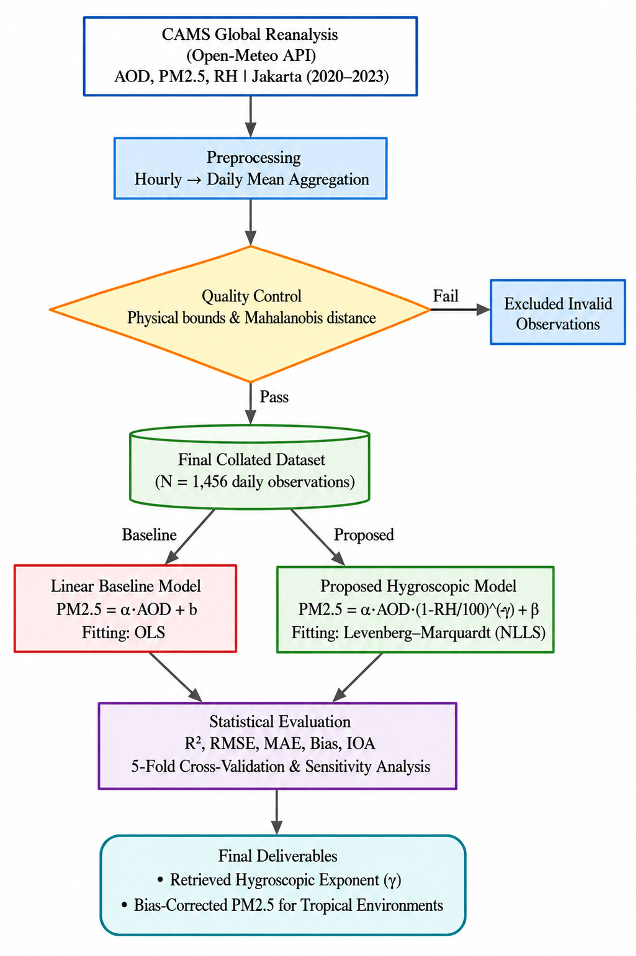
Fine particulate matter (PM2.5) estimation from satellite-derived Aerosol Optical Depth (AOD) is often biased in humid tropical environments because aerosol water uptake enhances optical extinction without a corresponding increase in dry particulate mass. This study develops a physics-informed, non-linear AOD-to-PM2.5 conversion framework that explicitly accounts for hygroscopic growth. Four years (2020–2023; N = 1.456 daily observations) of AOD, PM2.5, and relative humidity (RH) data from the Copernicus Atmosphere Monitoring Service (CAMS) global reanalysis over Jakarta, Indonesia, were used to quantify humidity-dependent bias and estimate an empirical hygroscopic exponent (gamma). The conventional linear model showed systematic overestimation under high-humidity conditions (RH > 80%), with a mean positive bias of 18.7 µgm-3. Incorporating the hygroscopic correction yielded gamma = 0.68 ± 0.04, increased R2 from 0.52 to 0.84, and reduced RMSE from 15.8 to 8.7 µgm-3. The estimated gamma remained stable across seasonal subsets, data-availability scenarios, and quality control thresholds and was consistent with reported values for urban-industrial aerosols. These results demonstrate that explicitly representing aerosol hygroscopicity can substantially improve AOD-based PM2.5 estimation in humid tropical environments. Although calibrated using CAMS reanalysis over Jakarta, the framework provides a physically interpretable and reproducible approach that can be applied to other regions after appropriate local recalibration.
References
Bai, K., K. Li, Y. Sun, L. Wu, Y. Zhang, N.-B. Chang, and Z. Li (2023). Global Synthesis of Two Decades of Research on Improving PM2.5 Estimation Models from Remote Sensing and Data Science Perspectives. Earth-Science Reviews, 241; 104461
Brown, H., X. Liu, R. Pokhrel, S. Murphy, Z. Lu, R. Saleh, T. Mielonen, H. Kokkola, T. Bergman, G. Myhre, R. B. Skeie, D. Watson-Parris, P. Stier, B. Johnson, N. Bellouin, M. Schulz, V. Vakkari, J. P. Beukes, P. G. van Zyl, et al. (2021). Biomass Burning Aerosols in Most Climate Models Are Too Absorbing. Nature Communications, 12(1)
Chin, M., T. Diehl, O. Dubovik, T. F. Eck, B. N. Holben, A. Sinyuk, and D. G. Streets (2009). Light Absorption by Pollution, Dust, and Biomass Burning Aerosols: A Global Model Study and Evaluation with AERONET Measurements. Annales Geophysicae, 27(9); 3439–3464
Ferijal, T., O. Batelaan, and M. Shanafield (2021). Spatial and Temporal Variation in Rainy Season Droughts in the Indonesian Maritime Continent. Journal of Hydrology, 603; 126999
Goddard, L. and M. Dilley (2005). El Niño: Catastrophe or Opportunity. Journal of Climate, 18(5); 651–665
Gu, Y., T. Fang, and S. H. L. Yim (2024). Source Emission Contributions to Particulate Matter and Ozone, and Their Health Impacts in Southeast Asia. Environment International, 186; 108578
Gualtieri, G., L. Brilli, F. Carotenuto, A. Cavaliere, B. Gioli, T. Giordano, S. Putzolu, C. Vagnoli, and A. Zaldei (2025). Assessing Capability of Copernicus Atmosphere Monitoring Service to Forecast PM2.5 and PM10 Hourly Concentrations in a European Air Quality Hotspot. Atmospheric Pollution Research, 16(8); 102567
Hand, J. L. and W. C. Malm (2007). Review of Aerosol Mass Scattering Efficiencies from Ground-Based Measurements Since 1990. Journal of Geophysical Research: Atmospheres, 112(D16)
Harris, C. R., K. J. Millman, S. J. van derWalt, R. Gommers, P. Virtanen, D. Cournapeau, E. Wieser, J. Taylor, S. Berg, N. J. Smith, R. Kern, M. Picus, S. Hoyer, and M. H. van Kerkwijk (2020). Array Programming with NumPy. Nature, 585; 357–362
Hoyer, S. and J. J. Hamman (2017). xarray: N-D Labeled Arrays and Datasets in Python; 1–6
Hunter, J. D. (2007). Matplotlib: A 2D Graphics Environment. Computing in Science and Engineering, 9(3); 90–95
Inness, A., M. Ades, A. Agustí-Panareda, J. Barré, A. Benedictow, A.-M. Blechschmidt, J. J. Dominguez, R. Engelen, H. Eskes, J. Flemming, V. Huijnen, L. Jones, Z. Kipling, S. Massart, M. Parrington, V.-H. Peuch, M. Razinger, S. Remy, M. Schulz, and M. Suttie (2019). The CAMS Reanalysis of Atmospheric Composition. Atmospheric Chemistry and Physics, 19; 3515–3556
Irwin, M., N. Robinson, J. D. Allan, H. Coe, and G. Mc-Figgans (2011). Size-Resolved Aerosol Water Uptake and Cloud Condensation Nuclei Measurements as Measured Above a Southeast Asian Rainforest During OP3. Atmospheric Chemistry and Physics, 11(21); 11157–11174
Jin, X., Z. Li, T. Wu, Y. Wang, T. Su, R. Ren, H. Wu, D. Zhang, S. Li, and M. Cribb (2022). Differentiating the Contributions of Particle Concentration, Humidity, and Hygroscopicity to Aerosol Light Scattering at Three Sites in China. Journal of Geophysical Research: Atmospheres, 127(24); e2022JD036891
Jose, K., R. K. Chaturvedi, C. Jeganathan, M. D. Behera, and C. P. Singh (2023). Plugging the Gaps in the Global PhenoCam Monitoring of Forests – The Need for a PhenoCam Network across Indian Forests
Kurokawa, J., T. Ohara, T. Morikawa, S. Hanayama, G. Janssens-Maenhout, T. Fukui, K. Kawashima, and H. Akimoto (2013). Emissions of Air Pollutants and Greenhouse Gases over Asian Regions During 2000–2008: Regional Emission Inventory in ASia (REAS) Version 2. Atmospheric Chemistry and Physics, 13(21); 11019–11058
Liu, L. and H. Li (2023). Hygroscopicity of Ultrafine Particles Containing Ammonium/Alkylaminium Sulfates: A Köhler Model Investigation with Correction of Surface Tension. Atmospheric Environment, 294; 119500
Lolli, S. (2025). Urban PM2.5 Concentration Monitoring: A Review of Recent Advances in Ground-Based, Satellite, Model, and Machine Learning Integration. Urban Climate, 63; 102566
Ma, Q., Y. Wu, S. Fu, D. Zhang, Z. Han, and R. Zhang (2020). Pollution Severity-Dependent Aerosol Light Scattering Enhanced by Inorganic Species Formation in Beijing Haze. Science of the Total Environment, 719; 137545
Malm, W. C. and D. E. Day (2001). Estimates of Aerosol Species Scattering Characteristics as a Function of Relative Humidity. Atmospheric Environment, 35(16); 2845–2860
McKinney, W. (2010). Data Structures for Statistical Computing in Python. In Proceedings of the 9th Python in Science Conference
More, J. J. (1977). Levenberg–Marquardt Algorithm: Implementation and Theory
Pedregosa, F., R. Weiss, and M. Brucher (2011). Scikit-Learn: Machine Learning in Python. Journal of Machine Learning Research, 12; 2825–2830
Petters, M. (2007). A Single Parameter Representation of Hygroscopic Growth and Cloud Condensation Nuclei Activity. Atmospheric Chemistry and Physics, 7
Riemer, N., A. P. Ault, M. West, R. L. Craig, and J. H. Curtis (2019). Aerosol Mixing State: Measurements, Modeling, and Impacts. Reviews of Geophysics, 57(2); 187–249
Sangkham, S., W. Phairuang, S. P. Sherchan, N. Pansakun, N. Munkong, K. Sarndhong, M. A. Islam, and P. Sakunkoo (2024). An Update on Adverse Health Effects from Exposure to PM2.5. Environmental Advances, 18; 100603
Seinfeld, J. H. and S. N. Pandis (2016). Atmospheric Chemistry and Physics: From Air Pollution to Climate Change. Wiley
Shinozuka, Y., A. D. Clarke, S. G. Howell, V. N. Kapustin, C. S. McNaughton, J. Zhou, and B. E. Anderson (2007). Aircraft Profiles of Aerosol Microphysics and Optical Properties over North America: Aerosol Optical Depth and Its Association with PM2.5 and Water Uptake. Journal of Geophysical Research: Atmospheres, 112; 1–13
Tang, Y., R. Deng, J. Li, Y. Liang, L. Xiong, Y. Liu, and R. Zhang (2021). Estimation of Ultrahigh Resolution PM2.5 Mass Concentrations Based on Mie Scattering Theory by Using Landsat-8 OLI Images over Pearl River Delta
Tong, H., X. Hu, C. Xia, X. Shen, Y. Zhang, Q. Liu, L. Liu, L. Liang, J. Lu, H. Che, X. Zhang, and J. Sun (2026). A Machine Learning-Based Model for Aerosol Scattering Hygroscopic Growth Factor (f(RH)) Prediction in Beijing Urban Area. Atmospheric Environment, 365; 121699
van Donkelaar, A., M. Hammer, L. Bindle, M. Brauer, J. Brook, M. Garay, N. Hsu, O. Kalashnikova, R. Kahn, C. Lee, R. Levy, A. Lyapustin, A. Sayer, and R. Martin (2021). Monthly Global Estimates of Fine Particulate Matter and Their Uncertainty. Environmental Science & Technology
Verma, S., T. Gangwar, J. Singh, D. Prakash, and S. Payra (2023). Urban Air Quality Monitoring and Modelling Using Ground Monitoring, Remote Sensing, and GIS. In F. Mushtaq, M. Farooq, A. B. Mukherjee, and M. Ghosh Nee Lala, editors, Geospatial Analytics for Environmental Pollution Modeling: Analysis, Control and Management. Springer Nature Switzerland, pages 213–247
Virtanen, P., R. Gommers, T. E. Oliphant, M. Haberland, T. Reddy, S. J. van der Walt, M. Brett, J. Wilson, and K. J. Millman (2020). SciPy 1.0: Fundamental Algorithms for Scientific Computing in Python. Nature Methods, 17
Wagner, A., Y. Bennouna, A. Blechschmidt, G. Brasseur, S. Chabrillat, Y. Christophe, Q. Errera, H. Eskes, J. Flemming, K. M. Hansen, A. Inness, J. Kapsomenakis, B. Langerock, A. Richter, N. Sudarchikova, and V. Thouret (2021). Comprehensive Evaluation of the Copernicus Atmosphere Monitoring Service (CAMS) Reanalysis Against Independent Observations: Reactive Gases
Wang, Y. (2024). Deriving PM2.5 from Satellite Observations with Spatiotemporally Weighted Tree-Based Algorithms: Enhancing Modeling Accuracy and Interpretability; 1–9
Waskom, M. L. (2021). Seaborn: Statistical Data Visualization Statement of Need. Journal of Open Source Software, 6; 1–4
Wei, Q., Y. Chen, H. Zhang, Z. Jia, J. Yang, and B. Niu (2025). Simulation and Prediction of PM2.5 Concentrations and Analysis of Driving Factors Using Interpretable Tree-Based Models in Shanghai, China. Environmental Research, 270; 121003
Wei, X., N.-B. Chang, K. Bai, and W. Gao (2020). Satellite Remote Sensing of Aerosol Optical Depth: Advances, Challenges, and Perspectives. Critical Reviews in Environmental Science and Technology, 50(16); 1640–1725
Woodage, M. J., A. Slingo, S. Woodward, and R. E. Comer (2010). U.K. HiGEM: Simulations of Desert Dust and Biomass Burning Aerosols with a High-Resolution Atmospheric GCM. Journal of Climate, 23(7); 1636–1659
Xu, X. and C. Zhang (2020). Estimation of Ground-Level PM2.5 Concentration Using MODIS AOD and Corrected Regression Model over Beijing, China. PLoS ONE, 15(10)
Yuan, S., Y. Li, J. Gao, and F. Bao (2022). A New Coupling Method for PM2.5 Concentration Estimation by the Satellite-Based Semiempirical Model and Numerical Model
Zhu, H., R. V. Martin, A. van Donkelaar, M. S. Hammer, C. Li, J. Meng, C. R. Oxford, X. Liu, Y. Li, D. Zhang, I. Singh, and A. Lyapustin (2024). Importance of Aerosol Composition and Aerosol Vertical Profiles in Global Spatial Variation in the Relationship between PM2.5 and Aerosol Optical Depth. Atmospheric Chemistry and Physics, 24(20); 11565–11584