
The Potential of Marine Yeast and Its Interaction with Mold in Degrading High-Density Polyethylene (HDPE)
Article Sidebar
-
Biodegradation, High-Density Polyethylene, Marine Yeast, Mold, Waste
Abstract
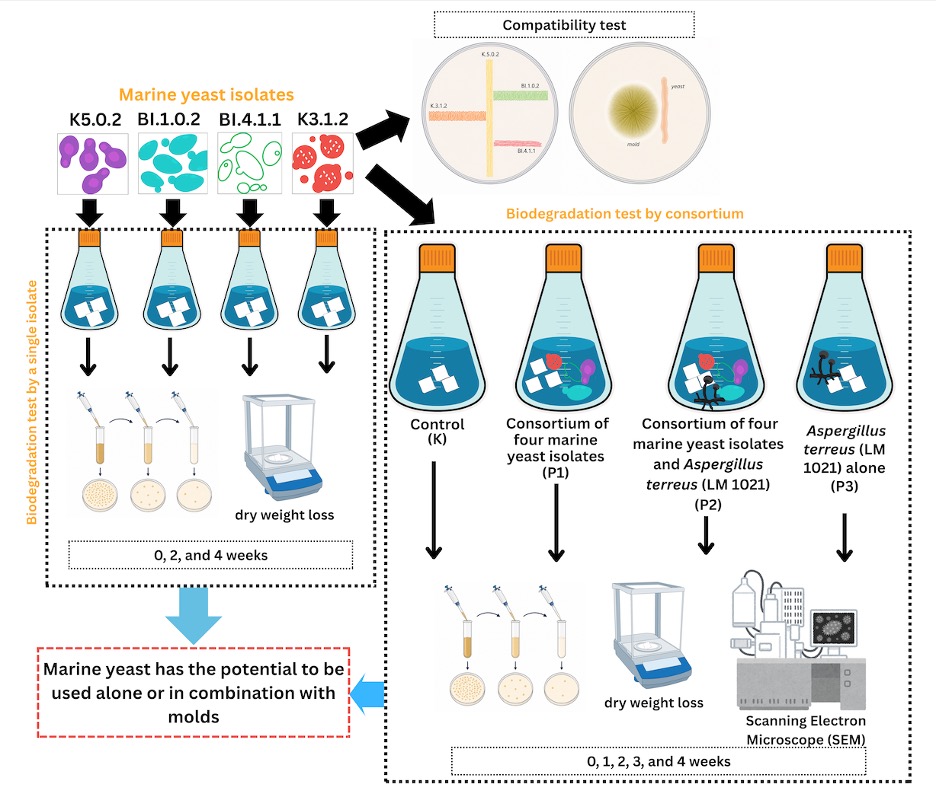
Indonesia is one of the countries that contributes significant amounts of plastic waste to coastal environments. High-density polyethylene (HDPE) is a petroleum-based synthetic thermoplastic and the primary source of environmental plastic pollution. The stable aliphatic chains with strong C–C bonds in HDPE render it recalcitrant to microbial degradation. Bioremediation through biodegradation by microorganisms can be an effective and environmentally friendly solution for eliminating HDPE from ecosystems. Several studies have suggested that microbial consortia may enhance plastic biodegradation. However, the effectiveness of marine yeast-mold interactions in HDPE degradation remains poorly understood. This study aimed to evaluate the potential of marine yeast to degrade HDPE and assess its effectiveness when combined with molds for HDPE degradation. The biodegradation experiment was conducted over 30 days using Mineral Salt Medium Broth (MSMB) and plastic sheets. The parameters assessed during biodegradation included degradation effectiveness (%), total count of heterotrophic microorganisms (CFU/mL), and Scanning Electron Microscope (SEM) analysis. The results show that marine yeast has the potential to be used alone or in combination with molds. The highest value was achieved by the P2 treatment group in week 4, which consisted of a consortium of marine yeast and mold, with a value of 4.855%. However, this was not significantly different from P1, which consisted of a consortium of marine yeast with a value of 4.17%. The SEM test results indicated biofilm formation in all treatments, suggesting plastic biodegradation activity.
References
Alami, N.H., N.D.Kuswytasari, E.Zulaika, andM.Shovitri (2017). Optimization of Cellulase Production by Candida G3.2 from the Rhizosphere of Gunung Anyar Mangrove Surabaya. In Proceeding of International Conference on Green Technology, volume 8. pages 399–406
Alami, N. H., Z. R. Puteri, T. Esaki, Y. Sugai, F. Pratama, I. A. Purwasena, and P. Aditiawati (2025b). Functional and Genomic Characterization of Polyethylene Degrading Yeast Meyerozyma Carpophila M6.0.2 Isolated from Marine Plastic Debris in East Java Indonesia. Scientific Reports, 15(1); 40437
Alami, N. H., M. A. P. Utomo, M. K. Zahro, A. N. Rani, P. Aditiawati, I. A. Purwasena, F. Pratama, N. D. Kuswytasari, E. Zulaika, and M. Shovitri (2023). Proceedings of International Symposium on Earth Science and Technology 2020. pages 520–523
Alexopoulos, C. J., C. W. Mims, and M. Blackwell (1996). Introductory Mycology. John Wiley and Sons, Inc., 4th edition
Amobonye, A., P. Bhagwat, S. Singh, and S. Pillai (2021). Plastic Biodegradation: Frontline Microbes and Their Enzymes. Science of The Total Environment, 759; 143536
Asri, A. C. and E. Zulaika (2016). Sinergisme Antar Isolat Azotobacter yang Dikonsorsiumkan. Jurnal Sains dan Seni ITS, 5(2); 57–59
Balasubramanian, V., K. Natarajan, B. Hemambika, N. Ramesh, C. S. Sumathi, R. Kottaimuthu, and V. Rajesh Kannan (2010). High-Density Polyethylene (HDPE)-Degrading Potential Bacteria from Marine Ecosystem of Gulf of Mannar, India. Letters in Applied Microbiology, 51(2); 205–211
Cheng, J., J. Jacquin, P. Conan, M. Pujo-Pay, V. Barbe, M. George, P. Fabre, S. Bruzaud, A. Ter Halle, A. L. Meistertzheim, and J. F. Ghiglione (2021). Relative Influence of Plastic Debris Size and Shape, Chemical Composition and Phytoplankton-Bacteria Interactions in Driving Seawater Plastisphere Abundance, Diversity and Activity. Frontiers in Microbiology, 11; 610231
Chi, Z., Z. Chi, T. Zhang, G. Liu, J. Li, and X. Wang (2009). Production, Characterization and Gene Cloning of the Extracellular Enzymes from the Marine-Derived Yeasts and Their Potential Applications. Biotechnology Advances, 27(3); 236–255
Dalal, J. M. and N. S. Kulkarni (2014). Antagonistic and Plant Growth Promoting Potentials of Indigenous Endophytic Actinomycetes of Soybean (Glycine max (L) Merrill). Centre for Info Bio Technology (CIBTech) Journal of Microbiology, 3(4); 1–12
Das, M. P. and S. Kumar (2015). An Approach to Low-Density Polyethylene Biodegradation by Bacillus Amyloliquefaciens. 3 Biotech, 5(1); 81–86
Doerffer, J. W. (1992). Oil Spill Response in the Marine Environment. Pergamon Press, 1st edition
Fesseha, H. and F. Abebe (2019). Degradation of Plastic Materials Using Microorganisms: A Review. Public Health – Open Journal, 4(2); 57–63
Fontanella, S., S. Bonhomme, M. Koutny, L. Husarova, J. M. Brusson, J. P. Courdavault, S. Pitteri, G. Samuel, G. Pichon, J. Lemaire, and A. M. Delort (2010). Comparison of the Biodegradability of Various Polyethylene Films Containing Pro-Oxidant Additives. Polymer Degradation and Stability, 95(6); 1011–1021
Gilan, I., Y. Hadar, and A. Sivan (2004). Colonization, Biofilm Formation and Biodegradation of Polyethylene by a Strain of Rhodococcus Ruber. Applied Microbiology and Biotechnology, 65(1); 97–104
Gong, Z., L. Jin, X. Yu, B. Wang, S. Hu, H. Ruan, Y. J. Sung, H. G. Lee, and F. Jin (2023). Biodegradation of Low Density Polyethylene by the Fungus Cladosporium sp. Recovered from a Landfill Site. Journal of Fungi, 9(6); 605
Jambeck, J. R., R. Geyer, C. Wilcox, T. R. Siegler, M. Perryman, A. Andrady, R. Narayan, and K. L. Law (2015). Plastic Waste Inputs from Land into the Ocean. Science, 347(6223); 768–771
Khatua, S., J.Simal-Gandara, andK.Acharya(2024). Myco-Remediation of Plastic Pollution: Current Knowledge and Future Prospects. Biodegradation, 35(3); 249–279
Kong, Y., R. Wang, Q. Zhou, J. Li, Y. Fan, and Q. Chen (2025). Recent Progresses and Perspectives of Polyethylene Biodegradation by Bacteria and Fungi: A Review. Journal of Contaminant Hydrology, 269; 104499
Kumar, S., A. K. Panda, and R. K. Singh (2011). A Review on Tertiary Recycling of High-Density Polyethylene to Fuel. Resources, Conservation and Recycling, 55(11); 893–910
Kurniawati, A. R. and M. Shovitri (2018). Kapang Tanah Mangrove Wonorejo Pendegradasi Plastik
Kutty, S. N. and R. Philip (2008). Marine yeasts - A review. Yeast, 25(7); 465–483
Kyaw, B. M., R. Champakalakshmi, M. K. Sakharkar, C. S. Lim, and K. R. Sakharkar (2012). Biodegradation of Low Density Polythene (LDPE) by Pseudomonas Species. Indian Journal of Microbiology, 52(3); 411–419
Law, K. L., N. Starr, T. R. Siegler, J. R. Jambeck, N. J. Mallos, and G. H. Leonard (2020). The United States’ Contribution of Plastic Waste to Land and Ocean. Science Advances, 6(44); abd0288
Li, F., D. Yu, X. Lin, D. Liu, H. Xia, and S. Chen (2012). Biodegradation of Poly(?- Caprolactone) (PCL) by a New Penicillium Oxalicum Strain DSYD05-1. World Journal of Microbiology and Biotechnology, 28(10); 2929–2935
Li, W. C., H. F. Tse, and L. Fok (2016). Plastic Waste in the Marine Environment: A Review of Sources, Occurrence and Effects. Science of The Total Environment, 566–567; 333–349
Mahalakshmi, V. and S. A. Siddiq (2015). Enhanced Biodegradation of Polyethylene by Development of a Consortium. Advances in Applied Science Research, 6(4); 183–189
Mbuge, D. O., L. O. Gumbe, and G. O. Rading (2011). Analysis of Natural Degradation of High-Density Polyethylene Lining Using Time-Dependent Properties. Polymer Engineering & Science, 51(6); 1198–1205
Ministry of Environment and Forestry (2020). National Plastic Waste Reduction Strategic Actions for Indonesia. Technical report
Miri, S., R. Saini, S. M. Davoodi, R. Pulicharla, S. K. Brar, and S. Magdouli (2022). Biodegradation of Microplastics: Better Late Than Never. Chemosphere, 286; 131670
Nadim, M., N.Saidi, I.W.Hasani, Y.Y.ElBanna, O.Samir, M. El Haj Assad, and S. Shamekh (2016). Effects of Some Environmental Parameters on Mycelia Growth of Finnish Truffle Tuber Maculatum. International Journal of Engineering and Applied Sciences (IJEAS), 3(8); 1–5
Ren, L., L. Men, Z. Zhang, F. Guan, J. Tian, B. Wang, J. Wang, Y. Zhang, and W. Zhang (2019). Biodegradation of Polyethylene by Enterobacter Sp. D1 from the Guts of Wax Moth Galleria Mellonella. International Journal of Environmental Research and Public Health, 16(11); 1941
Restrepo-Flórez, J. M., A. Bassi, and M. R. Thompson (2014). Microbial Degradation and Deterioration of Polyethylene - A Review. International Biodeterioration & Biodegradation, 88; 83–90
Russell, J. R., J. Huang, P. Anand, K. Kucera, A. G. Sandoval, K. W. Dantzler, D. S. Hickman, J. Jee, F. M. Kimovec, D. Koppstein, D. H. Marks, P. A. Mittermiller, S. J. Núñez, M. Santiago, M. A. Townes, M. Vishnevetsky, N. E. Williams, M. P. N. Vargas, L. A. Boulanger, and S. A. Strobel (2011). Biodegradation of Polyester Polyurethane by Endophytic Fungi. Applied and Environmental Microbiology, 77(17); 6076–6084
Sáenz, M., T. Borodulina, L. Diaz, and C. Banchon (2019). Minimal Conditions to Degrade Low Density Polyethylene by Aspergillus Terreus and Niger. Journal of Ecological Engineering, 20(6); 44–51
Sangdee, A., S. Kornphachara, and N. Srisawat (2016). In Vitro Screening of Antagonistic Activity of Soil Streptomyces against Plant Pathogenic Fungi and Assessment of Its Characters. Journal of Agricultural Technology, 12(1); 173–185
Sari, R. Y. K. (2021). Isolasi dan Screening Khamir Laut Pendegradasi High Density Polyethylene (HDPE) dari Kawasan Pantai di Banyuwangi, Surabaya, dan Gresik
Satlewal, A., R. Soni, M. G. H. Zaidi, Y. Shouche, and R. Goel (2008). Comparative Biodegradation of HDPE by Microbial Isolates. Journal of Microbiology and Biotechnology, 18(3); 477–482
Shovitri, M., H. Hefdiyah, T. R. Antika, N. D. Kuswytasari, N. H. Alami, E. Zulaika, S. W. Kim, and M. K. Oh (2023). Plastic-Degrading Bacteria Isolated from Contaminated Mangrove Sediment in Wonorejo, Surabaya. Applied Environmental Biotechnology, 8(2); 18–28
Skariyachan, S., N. Taskeen, A. P. Kishore, and B. V. Krishna (2022). Recent Advances in Plastic Degradation From Microbial Consortia-Based Methods to Data Sciences and Computational Biology Driven Approaches. Journal of Hazardous Materials, 426; 128086
Sowmya, H. V., B. Ramalingappa, G. Nayanashree, B. Thippeswamy, and M. Krishnappa (2015). Biodegradation of Polyethylene by Trichoderma Harzianum Strain SBT4. International Journal of Environmental Research, 9(3); 823–830
Sudhakar, M., M. Doble, P. S. Murthy, and R. Venkatesan (2008). Marine Microbe-Mediated Biodegradation of Low and High Density Polyethylenes. International Biodeterioration & Biodegradation, 61(3); 203–213
Syamsi, N., N. D. Kuswytasari, and M. Shovitri (2019). Pengaruh 1 ppm Ion Fe2+ dan Variasi pH terhadap Aktivitas Alkana hidroksilase Jamur Aspergillus terreus. Jurnal Sains dan Seni ITS, 8(2); 57–60
Tiago, G. A. O., A. Mariquito, S. Martins-Dias, and A. C. Marques (2023). The Problem of Polyethylene Waste - Recent Attempts for Its Mitigation. Science of The Total Environment, 892; 164629
Wang, Y., R. Karasik, and K. Takeaways (2022). Policy Brief Plastic Pollution Policy Country Profile: Indonesia. Technical report
Yang, W.K., Z.Gong, B.T.Wang, S.Hu, Y.Zhuo, C.Z.Jin, L. Jin, H. G. Lee, and F. J. Jin (2024). Biodegradation of low-density polyethylene by mixed fungi composed of Alternaria sp. and Trametes sp. isolated from landfill sites. BMC Microbiology, 24(1); 3477
Zaky, A. S., G. A. Tucker, Z. Y. Daw, and C. Du (2014). Marine Yeast Isolation and Industrial Application. FEMS Yeast Research, 14(6); 813–825
Zeenat, A.Elahi, D. A. Bukhari, S.Shamim, andA. Rehman (2021). Plastics Degradation by Microbes: A Sustainable Approach. Journal of King Saud University - Science, 33(6); 101538