
Evaluating Environmental Sustainability Performance through Green Industry Standards in Indonesian Ammonia Production
Article Sidebar
-
Green Industry Standard, Corporate Sustainability, Environmental Performance, Fertilizer Industry, Energy Intensity, Greenhouse Gas Emission
Abstract
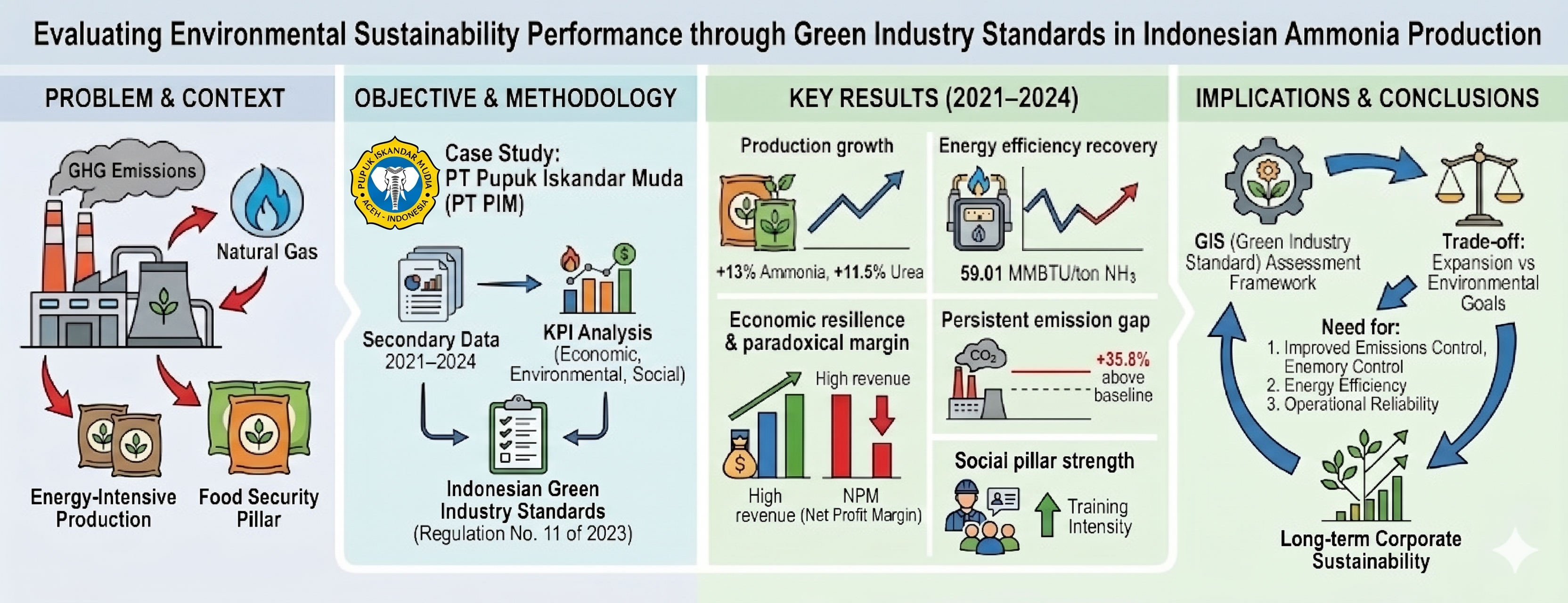
The fertilizer industry is a strategic sector that supports global food security. However, the production processes associated with this industry are characterized by high energy consumption and significant greenhouse gas emissions. The present study assesses environmental management and corporate sustainability performance within an integrated ammonia and urea production system based on Green Industry Standard (GIS) indicators. A quantitative descriptive approach was employed, whereby sustainability performance was measured through the use of key performance indicators (KPIs), trend analysis, and benchmarking against national GIS technical requirements. Secondary data from operational records, annual reports, and sustainability reports covering the period of 2021–2024 were analysed. The outcomes demonstrate that economic growth is concomitant with alterations in environmental and economic sustainability performance. Ammonia and urea production increased by 13% and 11.5%, respectively, while natural gas consumption intensity remained relatively stable, with only a 0.15% increase compared with the baseline period. However, greenhouse gas emission intensity exhibited a 35.8% increase compared to the 2021 baseline level, signifying that the effective management of emissions continues to pose a substantial challenge to the pursuit of sustainable industrial performance. From an economic vantage point, the augmentation in production capacity was accompanied by a 19.1% diminution in net profit margin, underscoring the necessity of achieving a balance between operational efficiency and environmental objectives. The findings indicate that Green Industry Standards offer a quantifiable framework for evaluating sustainability performance in energy-intensive fertilizer industries. To this end, there is an imperative for ongoing enhancement in emission reduction strategies, energy efficiency, and operational reliability. Such enhancements are crucial for fortifying environmental management practices and underpinning long-term corporate sustainability.
References
Amhamed, A. I., S. Shuibul Qarnain, S. Hewlett, A. Sodiq, Y. Abdellatif, R. J. Isaifan, and O. F. Alrebei (2022). Ammonia Production Plants—A Review. Fuels, 3(3); 408–435.
Carroll, A. B. (2015). Corporate Social Responsibility: The Centerpiece of Competing and Complementary Frameworks. Organizational Dynamics, 44(2); 87–96.
Cohen, M. A. and A. Tubb (2018). The Impact of Environmental Regulation on Firm and Country Competitiveness: A Meta-Analysis of the Porter Hypothesis. Journal of the Association of Environmental and Resource Economists, 5(2); 371–399.
Dyllick, T. and K. Muff (2016). Clarifying the Meaning of Sustainable Business: Introducing a Typology from Business-as-Usual to True Business Sustainability. Organization and Environment, 29(2); 156–174.
D’Eusanio, M., L. Petti, and M. Finkbeiner (2025). Beyond Product: Organizational LCA Methodologies for Sustainability Governance. The International Journal of Life Cycle Assessment, 30(12); 2677–2682.
Elkington, J. (1997). Cannibals with Forks: The Triple Bottom Line of 21st Century Business. Capstone Publishing Limited, 1 edition.
Erfani, N., L. Baharudin, and M. Watson (2024). Recent Advances and Intensifications in Haber-Bosch Ammonia Synthesis Process. Chemical Engineering and Processing—Process Intensification, 204.
Food and Agriculture Organization of the United Nations (2019). World Fertilizer Trends and Outlook to 2022. Technical report.
Ghavam, S., M. Vahdati, I. A. G. Wilson, and P. Styring (2021). Sustainable Ammonia Production Processes. Frontiers in Energy Research, 9.
Hameed, A. and F. Khan (2014). A Framework to Estimate the Risk-Based Shutdown Interval for a Processing Plant. Journal of Loss Prevention in the Process Industries, 32(1); 18–29.
Hasanah, J., S. Suripto, K. B. Wardianto, and M. Agung (2022). The Effect of Environmental Performance, Environmental Cost, Implementation of Environmental Management System (ISO 14001) and SDGs Support on Financial Performance of Mining Company in Indonesia Stock Exchange on 2016–2020. International Journal of Advanced Multidisciplinary Research and Studies, 2(3); 491–497.
International Energy Agency (2021). Ammonia Technology Roadmap: Towards More Sustainable Nitrogen Fertilizer Production. Technical report.
International Renewable Energy Agency and Ammonia Energy Association (2022). Innovation Outlook: Renewable Ammonia. Technical report.
Kementerian Perindustrian Republik Indonesia (2018). Peraturan Menteri Perindustrian Republik Indonesia Nomor 39 Tahun 2018 tentang Tata Cara Sertifikasi Industri Hijau.
Kementerian Perindustrian Republik Indonesia (2023). Peraturan Menteri Perindustrian Republik Indonesia Nomor 11 Tahun 2023 tentang Standar Industri Hijau untuk Amonia dan Pupuk Urea.
Kementerian PPN/Bappenas (2024). Laporan Kajian Lingkungan Hidup Strategis (KLHS) Rencana Pembangunan Jangka Panjang Nasional (RPJPN) Tahun 2025–2045. Laporan, Jakarta.
Ksi??ak, P. and B. Fischbach (2018). Triple Bottom Line: The Pillars of CSR. Journal of Corporate Responsibility and Leadership, 4(3); 95.
Kusumastuti, D. (2023). Pengembangan Industri Hijau Pada Industri Kecil Menengah (IKM) Batik Nirmala Sragen. Indonesia Berdaya, 4; 431–440.
Lee, K., X. Liu, P. Vyawahare, P. Sun, A. Elgowainy, and M. Wang (2022). Techno-Economic Performances and Life Cycle Greenhouse Gas Emissions of Various Ammonia Production Pathways Including Conventional, Carbon Capturing, Nuclear-Powered, and Renewable Production. Green Chemistry, 24(12); 4830–4844.
Liu, X., A. Elgowainy, and M. Wang (2020). Life Cycle Energy Use and Greenhouse Gas Emissions of Ammonia Production from Renewable Resources and Industrial By-Products. Green Chemistry, 22(17); 5751–5761.
Lozano, R. (2015). A Holistic Perspective on Corporate Sustainability Drivers. Corporate Social Responsibility and Environmental Management, 22(1); 32–44.
Majid, S., X. Zhang, M. B. Khaskheli, F. Hong, P. J. H. King, and I. H. Shamsi (2023). Eco-Efficiency, Environmental and Sustainable Innovation in Recycling Energy and Their Effect on Business Performance: Evidence from European SMEs. Sustainability, 15(12); 9465.
Mao, C., J. Byun, H. W. MacLeod, C. T. Maravelias, and G. A. Ozin (2024). Green Urea Production for Sustainable Agriculture. Joule, 8(5); 1224–1238.
Muryani (2017). Environmental Efficiency Policies Related to Porter’s Hypothesis. In Proceedings of the 2017 International Conference on Organizational Innovation (ICOI 2017), pages 181–187.
Padilla-Rivera, A., M. Hannouf, G. Assefa, and I. Gates (2025). Enhancing Environmental, Social, and Governance Performance and Reporting Through Integration of Life Cycle Sustainability Assessment Framework. Sustainable Development, 33(2); 2975–2995.
Schaltegger, S. and R. Burritt (2018). Business Cases and Corporate Engagement with Sustainability: Differentiating Ethical Motivations. Journal of Business Ethics, 147(2); 241–259.
Searcy, C. (2012). Corporate Sustainability Performance Measurement Systems: A Review and Research Agenda. Journal of Business Ethics, 107(3); 239–253.
Smith, C. and L. Torrente-Murciano (2024). The Importance of Dynamic Operation and Renewable Energy Source on the Economic Feasibility of Green Ammonia. Joule, 8(1); 157–174.
Styawati, I. H., A. Risdhianto, E. P. Duarte, H. Z. Almubaroq, and R. Falefi (2023). Manajemen Green Industry dan Implikasinya Terhadap Keamanan Lingkungan. JAMI: Jurnal Ahli Muda Indonesia, 4(2); 169–180.
Wahab, B. A. (2025). Environmental Regulations and BRICS Export Flows: An Empirical Test of the Porter Hypothesis. Journal of Economic Structures, 15; 3.