
The Role of Institutional Support in Influencing Environmental Attitudes Through Environmental Awareness in the Palm Oil Processing Industry in West Sumatra
Article Sidebar
-
Institutional Support, Environmental Awareness, Environmental Attitudes, Variance-Based Structural Equation Modelling, Palm Oil Industry Managers
Abstract
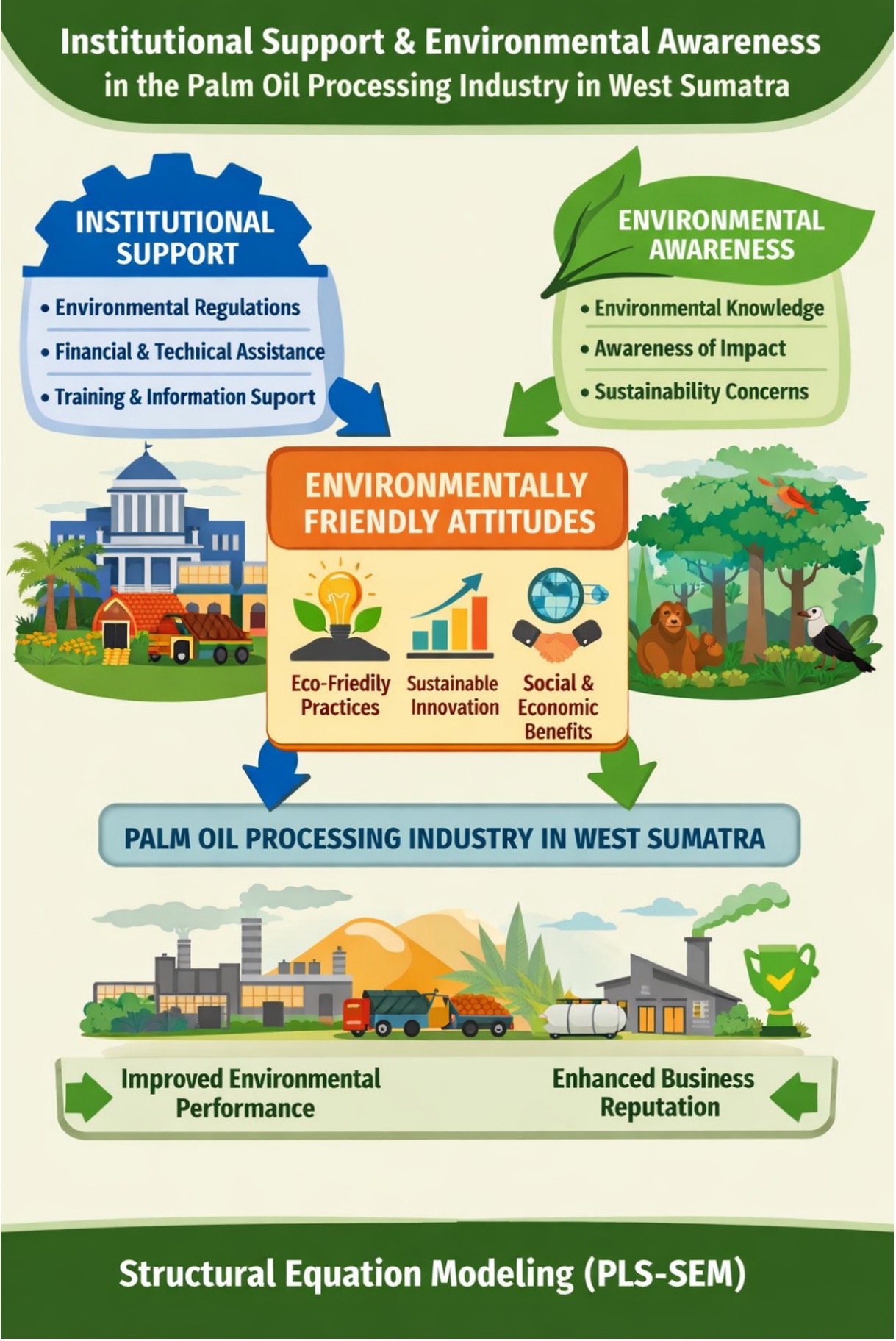
Despite its strategic role in the Indonesian economy, the palm oil processing industry also has the potential to create significant environmental problems and is facing increasing pressure to adopt environmental practices due to sustainability concerns and regulatory demands. In this context, institutional support is considered crucial in shaping pro-environmental behaviour. However, empirical studies explaining how institutional support shapes environmental awareness and attitudes are still limited, particularly in the palm oil industry in developing regions. Furthermore, institutional support in developing countries, including Indonesia, remains diverse and has not yet fully supported sustainable practices at the organizational level. Therefore, this study aims to explore the potential impact of institutional support on shaping environmental attitudes through environmental awareness, thus providing managerial implications for palm oil industry managers in West Sumatra, Indonesia. This study uses organizational level analysis, with data obtained from managers as a representation of the organization collected through a survey of 112 managers working in palm oil processing companies in West Sumatra using purposive sampling and analysed using variance-based structural equation modelling. The results of the study indicate that institutional support has a significant positive effect on environmental awareness (? = 0.666, t = 13.079, p < 0.000) and environmental attitudes (? = 0.573, t = 10.475, p < 0.000). Environmental awareness also has a significant positive effect on environmental attitudes (? = 0.716, t = 8.184, p < 0.000), and environmental awareness partially mediates the relationship between institutional support and environmental attitudes (? = 0.532, t = 9.512, p < 0.00). Based on these findings, it is important to strengthen environmental governance through regulations as a reflection of institutional support. Therefore, policymakers and industry stakeholders are encouraged to strengthen institutional systems to accelerate the process of change towards environmentally friendly practices.
References
Adrita, U. W. and M. F. Mohiuddin (2020). Impact of Opportunity and Ability to Translate Environmental Attitude into Ecologically Conscious Consumer Behavior. Journal of Marketing Theory and Practice, 28(2); 173–186
Ahmad, S., W. Mohti, M. Khan, M. Irfan, and O. K. Bhatti (2026). Creating a Bridge between ESG and Firm’s Financial Performance in Asian Emerging Markets: Catalytic Role of Managerial Ability and Institutional Quality. Journal of Economic and Administrative Sciences, 42(2); 496–518
Ajzen, I. (1991). The Theory of Planned Behavior. Organizational Behavior and Human Decision Processes, 50(2); 179–211
Asad, M., M. A. Bait Ali Sulaiman, A. M. S. Ba Awain, M. Alsoud, Z. Allam, and M. U. Asif (2024). Green Entrepreneurial Leadership, and Performance of Entrepreneurial Firms: Does Green Product Innovation Mediates? Cogent Business & Management, 11(1); 2355685
Awwad, A., A. L. M. Anouze, and S. Elbanna (2026). Green Product Innovation: Influences on Environmental Sustainability Performance. Management Decision, 64(3); 935–958
Ayompe, L. M., M. Schaafsma, and B. N. Egoh (2021). Towards Sustainable Palm Oil Production: The Positive and Negative Impacts on Ecosystem Services and Human Wellbeing. Journal of Cleaner Production, 278; 123914
Bamberg, S. and G. Möser (2007). Twenty Years After Hines, Hungerford, and Tomera: A New Meta-Analysis of Psycho-Social Determinants of Pro-Environmental Behaviour. Journal of Environmental Psychology, 27(1); 14–25
Candrianto, I. Mouludi, F. Jamsan, M. A. Gusti, and A. Satrianto (2026). Green Supply Chain Management as a Response to Coercive and Normative Institutional Pressures on Green Innovation. International Journal of Sustainable Development and Planning, 21(1); 139–149
Candrianto, C., H. Aimon, and S. U. Sentosa (2023). The Role of Knowledge, Awareness and Environmental Attitudes in Green Product Management. Global Journal of Environmental Science & Management, 9(1); 101–112
Cao, H. and Z. Chen (2019). The Driving Effect of Internal and External Environment on Green Innovation Strategy: The Moderating Role of Top Management’s Environmental Awareness. Nankai Business Review International, 10(3); 342–361
Chong, T. and L. Loh (2023). Innovating ESG Integration as Sustainable Strategy: ESG Transparency and Firm Valuation in the Palm Oil Sector. Sustainability, 15(22); 15943
Evans, J. R. and A. Mathur (2018). The Value of Online Surveys: A Look Back and a Look Ahead. Internet Research, 28(4); 854–887
Fikru, M. G. (2016). Determinants of International Standards in Sub-Saharan Africa: The Role of Institutional Pressure from Different Stakeholders. Ecological Economics, 130; 296–307
Hachana, R., T. Najar, and S. Ivanaj (2025). Exploring the Effect of Institutional Trust on the Relationship Between Environmental Consciousness and Household Recycling Behavior. Environmental Management, 75(4); 852–866
Hair, J. F., G. T. M. Hult, C. M. Ringle, M. Sarstedt, N. P. Danks, and S. Ray (2021). Partial Least Squares Structural Equation Modeling (PLS-SEM) Using R: A Workbook. Springer
Hajar, S. and E. Xia (2026). The Effects of Green Organizational Practices on Employee Pro-Environmental Behaviors: The Roles of Environmental Awareness and Employee Green Advocacy. Sustainability, 18(7); 3378
He, Y., Z. Liu, and M.-J. Lee (2024). Navigating Sustainable Value Creation Through Digital Leadership Under Institutional Pressures: The Moderating Role of Environmental Turbulence. Sustainability, 16(21); 9169
Kalyar, M. N., A. Shoukat, and I. Shafique (2020). Enhancing Firms’ Environmental Performance and Financial Performance Through Green Supply Chain Management Practices and Institutional Pressures. Sustainability Accounting, Management and Policy Journal, 11(2); 451–476
Khan, A.J., W.U.Hameed, T.Ahmed, J.Iqbal, M.J.Aplin, and S. Leahy (2024). Green Behaviors and Innovations: A Green HRM Perspective to Move from Traditional to Sustainable Environmental Performance. Employee Responsibilities and Rights Journal, 36(2); 231–248
Kollmuss, A. and J. Agyeman (2002). Mind the Gap: Why Do People Act Environmentally and What Are the Barriers to Pro-Environmental Behavior? Environmental Education Research, 8(3); 239–260
Li, X., N. Wang, B. Jiang, and T. Jia (2023a). Institutional Pressures and Proactive Environmental Strategy: The Mediating Effect of Top Managerial Environment Attitude and the Moderating Effect of New Media Pressure. Business Strategy and the Environment, 32(8); 6106–6123
Li, Z., H. Yu, and L. Xing (2023b). The Impact of Green Culture on Employees’ Green Behavior: The Mediation Role of Environmental Awareness. Corporate Social Responsibility and Environmental Management, 30(3); 1325–1335
Liem, V. T. and N. N. Hien (2024). The Impact of Managers’ Attitudes Towards Environmental Management Accounting and Green Competitive Advantage in Vietnam Manufacturers. Heliyon, 10(13)
Mehraban, N., B. L. Debela, U. Kalsum, and M. Qaim (2022). What About Her? Oil Palm Cultivation and Intra-Household Gender Roles. Food Policy, 110; 102276
Meijaard, E., T. M. Brooks, K. M. Carlson, E. M. Slade, J. Garcia-Ulloa, D. L. A. Gaveau, J. S. H. Lee, T. Santika, D. Juffe-Bignoli, and M. J. Struebig (2020). The Environmental Impacts of Palm Oil in Context. Nature Plants, 6(12); 1418–1426
Memon, M. A., H. Ting, J.-H. Cheah, R. Thurasamy, F. Chuah, and T. H. Cham (2020). Sample Size for Survey Research: Review and Recommendations. Journal of Applied Structural Equation Modeling, 4(2); i–xx
Nurnasfi, Z., N. Milantara, and T. H. A. Putra (2025). Estimasi Emisi Karbondioksida Equivalen Dari Perubahan Tutupan Lahan Di Hutan Lindung KPHL Pasaman Raya. Sumatera Tropical Forest Research Journal, 9(1); 467–476. (in Indonesia)
Obilor, E. I. (2023). Convenience and Purposive Sampling Techniques: Are They the Same. International Journal of Innovative Social & Science Education Research, 11(1); 1–7
Podsakoff, P. M., S. B. MacKenzie, J.-Y. Lee, and N. P. Podsakoff (2003). Common Method Biases in Behavioral Research: A Critical Review of the Literature and Recommended Remedies. Journal of Applied Psychology, 88(5); 879–903
Purnomo, H., B. Okarda, A. Dermawan, Q. P. Ilham, P. Pacheco, F. Nurfatriani, and E. Suhendang (2020). Reconciling Oil Palm Economic Development and Environmental Conservation in Indonesia: A Value Chain Dynamic Approach. Forest Policy and Economics, 111; 102089
Qu, Y., Y. Liu, R. R. Nayak, and M. Li (2015). Sustainable Development of Eco-Industrial Parks in China: Effects of Managers’ Environmental Awareness on the Relationships Between Practice and Performance. Journal of Cleaner Production, 87; 328–338
Rafiq, M., D. Xiuqing, and M. Sajid (2026). Is the Hotel Really Green? Creative Behaviour, Environmental Awareness and Green Training. Management Decision; 1–18
Roxas, B. and A. Coetzer (2012). Institutional Environment, Managerial Attitudes and Environmental Sustainability Orientation of Small Firms. Journal of Business Ethics, 111(4); 461–476
Rustiadi, E., A. E. Pravitasari, R. A. Priatama, J. Singer, J. Junaidi, Z. Zulgani, and R. I. Sholihah (2023). Regional Development, Rural Transformation, and Land Use/Cover Changes in a Fast-Growing Oil Palm Region: The Case of Jambi Province, Indonesia. Land, 12(5); 1059
Safari, A., R. Salehzadeh, R. Panahi, and S. Abolghasemian (2018). Multiple Pathways Linking Environmental Knowledge and Awareness to Employees’ Green Behavior. Corporate Governance, 18(1); 81–103
Scott, W. R. (2017). Institutional Theory: Onward and Upward. In The Sage Handbook of Organizational Institutionalism. pages 853–871
Sehar, A., Orangzab, M. Akbar, P. Poulova, A. Vasudevan, and T. Huang (2025). Understanding the Drivers of a Pro-Environmental Attitude in Higher Education Institutions: The Interplay Between Knowledge, Consciousness, and Social Influence. Frontiers in Environmental Science, 12; 1458698
Shah, S. S. and Z. Asghar (2024). Individual Attitudes Towards Environmentally Friendly Choices: A Comprehensive Analysis of the Role of Legal Rules, Religion, and Confidence in Government. Journal of Environmental Studies and Sciences, 14(4); 629–651
Shmueli, G., M. Sarstedt, J. F. Hair, J.-H. Cheah, H. Ting, S. Vaithilingam, and C. M. Ringle (2019). Predictive Model Assessment in PLS-SEM: Guidelines for Using PLSpredict. European Journal of Marketing,53(11); 2322–2347
Shu, C., D. De Clercq, Y. Zhou, and C. Liu (2019). Government Institutional Support, Entrepreneurial Orientation, Strategic Renewal, and Firm Performance in Transitional China. International Journal of Entrepreneurial Behavior & Research, 25(3); 433–456
Sitinjak, C., R. Ismail, Z. Tahir, R. Fajar, W. F. Simanullang, E. Bantu, K. Samuel, R. A. C. Rose, M. R. M. Yazid, and Z. Harun (2022). Acceptance of ELV Management: The Role of Social Influence, Knowledge, Attitude, Institutional Trust, and Health Issues. Sustainability, 14(16); 10201
Syahza, A. and B. Asmit (2020). Development of Palm Oil Sector and Future Challenge in Riau Province, Indonesia. Journal of Science and Technology Policy Management, 11(2); 149–170
Tan, Y. and Z. Zhu (2022). The Effect of ESG Rating Events on Corporate Green Innovation in China: The Mediating Role of Financial Constraints and Managers’ Environmental Awareness. Technology in Society, 68; 101906
Teng, S., K. W. Khong, and N. C. Ha (2020). Palm Oil and Its Environmental Impacts: A Big Data Analytics Study. Journal of Cleaner Production, 274; 122901
Tian, H., J. Zhang, and J. Li (2020). The Relationship Between Pro-Environmental Attitude and Employee Green Behavior: The Role of Motivational States and Green Work Climate Perceptions. Environmental Science and Pollution Research, 27(7); 7341–7352
Wardhani, R. and Y. Rahadian (2021). Sustainability Strategy of Indonesian and Malaysian Palm Oil Industry: A Qualitative Analysis. Sustainability Accounting, Management and Policy Journal, 12(5); 1077–1107
Wu, M.-J., K. Zhao, and F. Fils-Aime (2022). Response Rates of Online Surveys in Published Research: A Meta-Analysis. Computers in Human Behavior Reports, 7; 100206
Yang, M. X., X. Tang, M. L. Cheung, and Y. Zhang (2021). An Institutional Perspective on Consumers’ Environmental Awareness and Pro-Environmental Behavioral Intention: Evidence from 39 Countries. Business Strategy and the Environment, 30(1); 566–575
Yi, G. (2021). From Green Entrepreneurial Intentions to Green Entrepreneurial Behaviors: The Role of University Entrepreneurial Support and External Institutional Support. International Entrepreneurship and Management Journal, 17(2); 963–979
Yu, H. and Z. Li (2025). Organizational Green Culture and Employees’ Green Behavior: A Moderated Mediation Model with Employees’ Environmental Awareness and Organizational Disseminative Capacity. The Service Industries Journal, 45(11–12); 1018–1040
Yuslaini, N., U. Suwaryo, N. A. Deliarnoor, and D. Sri Kartini (2023). Palm Oil Industry and Investment Development in Dumai City, Indonesia: A Focus on Local Economy Development and Sustainability. Cogent Social Sciences, 9(1); 2235780
Zacher, H., C. W. Rudolph, and I. M. Katz (2023). Employee Green Behavior as the Core of Environmentally Sustainable Organizations. Annual Review of Organizational Psychology and Organizational Behavior, 10(1); 465–494
Zaid, W. M. A. and M. Z. Yaqub (2024). The Prolificacy of Green Transformational Leadership in Shaping Employee Green Behavior During Times of Crises in Small and Medium Enterprises: A Moderated Mediation Model. Frontiers in Psychology, 15; 1258990
Zhang, Q., X. Zhu, and M.-J. Lee (2024). Exploring Institutional Pressures, Green Innovation, and Sustainable Performance: Examining the Mediated Moderation Role of Entrepreneurial Orientation. Sustainability, 16(5); 2058
Zhang, T., P.-S. Seet, J. Redmond, and J. Sharafizad (2026). When the Going Gets Tough, Who Gets Going? Relational Embeddedness, Institutional Support and Entrepreneurial Continuance: Evidence from China’s Small Business Owners. Asia-Pacific Journal of Business Administration; 1–27
Zhao, S., L. Teng, and J. Ji (2024). Impact of Environmental Regulations on Eco-Innovation: The Moderating Role of Top Managers’ Environmental Awareness and Commitment. Journal of Environmental Planning and Management, 67(10); 2229–2256