
Entrepreneurship-Based Green Finance Model: Optimizing the Role of Regional-Owned Enterprises (BUMD) in Achieving Jakarta’s Net Zero Emission 2060 Target
Article Sidebar
-
Green Finance, Innovativeness, Proactivenes, Risk-Taking, Sustainability Performance, BUMD
Abstract
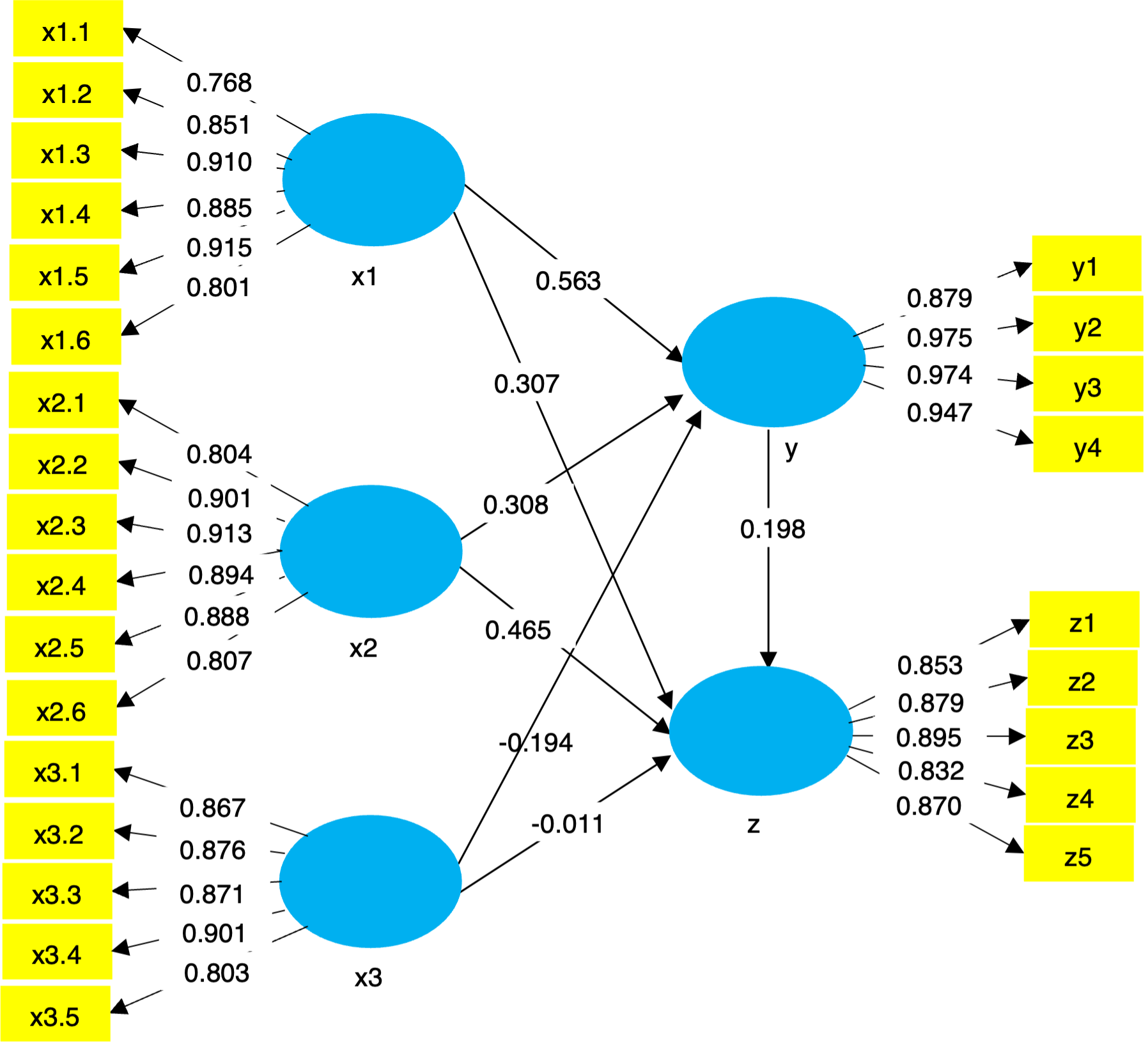
This study aims to examine and analyze the effects of willingness to innovate, proactive attitude, and risk-taking propensity on green finance and sustainability performance among Regional-Owned Enterprises (BUMD) in DKI Jakarta. The research employs a quantitative method using Structural Equation Modeling with Partial Least Squares (SEM-PLS) analysis, based on primary survey data collected from 23 BUMDs in Jakarta in 2025. The findings reveal that willingness to innovate and proactive attitude positively contribute to strengthening green finance; however, only the proactive attitude consistently enhances sustainability performance. Conversely, the willingness to take risks shows a negative effect on green finance and an insignificant impact on sustainability performance. Furthermore, green finance exerts a positive, though not yet significant, influence on sustainability performance. These findings underscore the need for operational strategies such as strengthening green innovation, establishing sustainability teams, implementing green risk management, and developing sustainability reports as integral components of transparent and accountable governance. Such strategies are essential to reinforce the strategic role of BUMDs in supporting the transition toward a green economy and achieving Jakarta’s Net Zero Emission 2060 target.
References
Amankwah, J. and H. Sesen (2021). On the Relation Between Green Entrepreneurship Intention and Behavior. Sustainability, 13(13); 7474
Burritt, R. L., T. Hahn, and S. Schaltegger (2002). Towards a Comprehensive Framework for Environmental Management Accounting: Links Between Business Actors and Environmental Management Accounting Tools. Australian Accounting Review, 12(28); 39–50
Covin, J. G. and G. T. Lumpkin (2011). Entrepreneurial Orientation Theory and Research: Reflections on a Needed Construct. Entrepreneurship Theory and Practice, 35(5); 855–872
De Marchi, V. (2012). Environmental Innovation and R&D Cooperation: Empirical Evidence From Spanish Manufacturing Firms. Research Policy, 41(3); 614–623
Dickel, P. and G. Eckardt (2021). Who Wants to Be a Social Entrepreneur? The Role of Gender and Sustainability Orientation. Journal of Small Business Management, 59(1); 1–23
Fatoki, O. (2019). Green Entrepreneurial Orientation and Firm Performance in South Africa. Entrepreneurship and Sustainability Issues, 7(1); 247–262
Feng, S., R. Zhang, and G. Li (2022). Environmental Decentralization, Digital Finance and Green Technology Innovation. Structural Change and Economic Dynamics, 61(2); 70–83
Formentini, M. and P. Taticchi (2016). Corporate Sustainability Approaches and Governance Mechanisms in Sustainable Supply Chain Management. Journal of Cleaner Production, 112(3); 1920–1933
Freudenreich, B., F. Lüdeke-Freund, and S. Schaltegger (2020). A Stakeholder Theory Perspective on Business Models: Value Creation for Sustainability. Journal of Business Ethics, 166(1); 3–18
Gilbert, S. and Z. Lihuan (2012). The Knowns and Unknowns of China’s Green Finance. Technical Report 5
Hair, J. F., J. J. Risher, M. Sarstedt, and C. M. Ringle (2019). When to Use and How to Report the Results of PLS-SEM. European Business Review, 31(1); 2–24
He, F., C. Ding, W. Yue, and G. Liu (2023). ESG Performance and Corporate Risk-Taking: Evidence From China. International Review of Financial Analysis, 87(102550); 1–15
Henseler, J., C. M. Ringle, and M. Sarstedt (2015). A New Criterion for Assessing Discriminant Validity in Variance-Based Structural Equation Modeling. Journal of the Academy of Marketing Science, 43(1); 115–135
Höhne, N., S. Khosla, H. Fekete, and A. Gilbert (2012). Mapping of Green Finance Delivered by IDFC Members in 2011. Technical Report 1, Cologne
Jiang, W., H. Chai, J. Shao, and T. Feng (2018). Green Entrepreneurial Orientation for Enhancing Firm Performance: A Dynamic Capability Perspective. Journal of Cleaner Production, 198(1); 1311–1323
Kwilinski, A., O. Lyulyov, and T. Pimonenko (2023). Spillover Effects of Green Finance on Attaining Sustainable Development: Spatial Durbin Model. Computation, 11(10); 199
Luvito, A., D. Kusnandar, and F. Rizqillah (2024). The Effect of Green Banking Implementation, Capital Structure, and Financial Performance on Company Value. Journal of Investment, Development, and Application, 5(1); 25–34
Prabowo, A. and I. Sartika (2025). Strategi Pembiayaan Berkelanjutan dalam Penyediaan Perumahan Layak Huni Bagi Masyarakat Berpenghasilan Rendah: Sebuah Analisis Bibliometrik. Indonesian Journal of Humanities, Social Sciences and Business (IJHSSB), 5(2); 315–326
Prasetya, S. G. (2025). Exploratory Factor Analysis: Measurement of Company Green Finance in Indonesia. Revista de Métodos Cuantitativos para la Economía y la Empresa, 40(1); 1–20
Putri, W. E. C., A. Zamroni, R. F. Ceballos, and R. C. Nolos (2026). Corporate Social Responsibility and Climate Action: Assessing Indonesian Mining Companies’ Contributions to SDG 13. Indonesian Journal of Environmental Management and Sustainability, 10(1); 17–28
Sarstedt, M., J. F. Hair, M. Pick, B. D. Liengaard, L. Radomir, and M. C. Ringle (2022). Progress in Partial Least Squares Structural Equation Modeling Use in Marketing Research in the Last Decade. Psychology & Marketing, 39(5); 1035–1064
Schaltegger, S. and M. Wagner (2011). Sustainable Entrepreneurship and Sustainability Innovation: Categories and Interactions. Business Strategy and the Environment, 20(4); 222–237
Sun, H. and F. Chen (2022). The Impact of Green Finance on China’s Regional Energy Consumption Structure Based on System GMM. Resources Policy, 76(102588); 1–11
Wales, W. J., V. K. Gupta, and F.-T. Mousa (2013). Empirical Research on Entrepreneurial Orientation: An Assessment and Suggestions for Future Research. International Small Business Journal, 31(4); 357–383
Wang, C. L. (2008). Entrepreneurial Orientation, Learning Orientation, and Firm Performance. Entrepreneurship Theory and Practice, 32(4); 635–657
Wheelen, T. L. and J. D. Hunger (2012). Strategic Management and Business Policy: Toward Global Sustainability. Pearson, New York, 13th edition
Wiklund, J. and D. Shepherd (2005). Entrepreneurial Orientation and Small Business Performance: A Configurational Approach. Journal of Business Venturing, 20(1); 71–91
Xue, Q., H. Wang, and C. Bai (2023). Local Green Finance Policies and Corporate ESG Performance. International Review of Finance, 23(4); 812–823
Zhang, H., C. Geng, and J. Wei (2022). Coordinated Development Between Green Finance and Environmental Performance in China: The Spatial-Temporal Difference and Driving Factors. Journal of Cleaner Production, 346(131150); 1–14
Zhao, L., D. Wang, X. Wang, and Z. Zhang (2023). Impact of Green Finance on Total Factor Productivity of Heavily Polluting Enterprises: Evidence From Green Finance Reform and Innovation Pilot Zone. Economic Analysis and Policy, 79(1); 477–490