
Improved Environmental Management Performance in the Crude Palm Oil (CPO) Production Process using a Life Cycle Assessment Approach
Article Sidebar
-
CPO, Cradle-to-Gate, Environmental Impact, LCA
Abstract
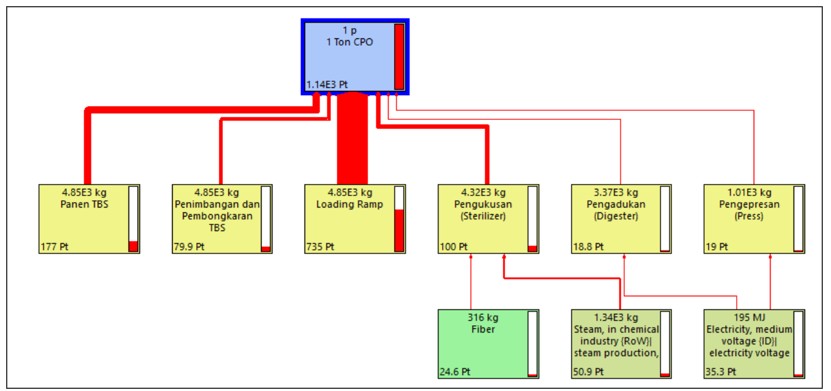
The palm oil production process at XYZ company, from the plantation subsystem, such as maintenance and harvesting, to processing in the mill, has the potential for significant environmental impacts, including greenhouse gas emissions from the use of diesel fuel. This study aims to evaluate the potential environmental impacts of producing one ton of Crude Palm Oil (CPO) at XYZ company using a Life Cycle Assessment (LCA) with a cradle-to-gate approach. The CML-IA Baseline method was employed, focusing on three main impact categories: Global Warming Potential (GWP 100a), Acidification Potential (AP), and Eutrophication Potential (EP). Primary data were collected directly from XYZ company through interviews, observations, and documentation, supported by relevant secondary data. Life Cycle Inventory (LCI) analysis quantified inputs such as fertilizers, diesel fuel, and electricity, as well as outputs in the form of liquid and solid waste. The Life Cycle Impact Assessment (LCIA) results indicate that factory processing operations are the primary contributors to environmental impacts. The GWP 100a impact value was identified as 2×10? kg CO? eq./ton CPO, the AP value as 18.5 kg SO? eq./ton CPO, and the EP value as 7.8 kg PO? eq./ton CPO, with the most significant contributions coming from diesel fuel consumption and electricity use in the loading ramp process. Improvement recommendations focus on optimizing the replacement of diesel fuel with biodiesel to minimize the impact.
References
Azmi, U., S. Murtiana, N. A. Sasongko, and S. Yanto (2025). Critical Minerals Life Cycle Assessment (LCA): Sustainable Mining Practices. Formosa Journal of Applied Sciences, 4(3); 883–902.
Bessou, C. and L. Pardon (2017). Environmental Impacts of Palm Oil Products: What Can We Learn from LCA? IJoLCAS, 1; 1–7.
Chaerul, M. and V. Allia (2019). Tinjauan Kritis Studi Life Cycle Assessment (LCA) di Indonesia. Jurnal Serambi Engineering, 5(1); 816–823. (in Indonesia).
Courtat, M., P. J. Joyce, S. Sim, J. Sadhukhan, and R. Murphy (2023). Towards Credible, Evidence-Based Environmental Rating Ecolabels for Consumer Products: A Proposed Framework. Journal of Environmental Management, 336; 117684.
Dwi, A., E. Sribudiani, A. Priyanti, D. Yulistiani, H. Daulay, R. Hanifa, I. G. Ayu, P. Mahendri, U. K. Yaumidin, A. Ali, E. Erwan, D. Iskandar, and I. Nurhayati (2025). Case Studies in Chemical and Environmental Engineering Sustainable Utilization of Palm Oil Industry By-Products for Livestock Feed: A Digestibility and Environmental Assessment. Case Studies in Chemical and Environmental Engineering, 12; 101263.
Harimurti, D., H. Hariyadi, and E. Noor (2021). Pengurangan Emisi Gas Rumah Kaca pada Perkebunan Kelapa Sawit dengan Pendekatan Life Cycle Assessment. Jurnal Pengelolaan Sumberdaya Alam dan Lingkungan (Journal of Natural Resources and Environmental Management), 11(1); 1–9. (in Indonesia).
Hawari, N. A. (2021). Life Cycle Assessment (LCA) untuk Rantai Pasok Agroindustri Perkebunan Kelapa Sawit. Jurnal Ekonomi, 18(1); 41–49. (in Indonesia).
Heidari, A., H. Boleydei, A. Rohani, H. R. Lu, and H. Younesi (2022). Integrating Life Cycle Assessment and Life Cycle Costing Using TOPSIS to Select Sustainable Biomass-Based-Carbonaceous Adsorbents for CO? Capture. Journal of Cleaner Production, 357; 131968.
Khairulya, D. and Sudradjat (2016). Penggunaan Biost untuk Mengurangi Dosis Pupuk Tunggal NPK pada Tanaman Kelapa Sawit Umur Dua Tahun. Agrovigor, 9(1); 1–10. (in Indonesia).
Klöpffer, W., M. A. Curran, M. Z. Hauschild, and M. A. J. Huijbregts (2023). LCA Compendium: The Complete World of Life Cycle Assessment. Springer, Dordrecht.
Maisarah, M. and R. Dian (2024). Metode Life Cycle Assessment (LCA) dalam Penilaian Dampak Lingkungan Industri Kelapa Sawit untuk Kelapa Sawit Berkelanjutan. Tabela Jurnal Pertanian Berkelanjutan, 2(1); 15–23. (in Indonesia).
MBI (2021). Seminar Nasional Biodiversitas. Seminar Nasional Biodiversitas, 8(1); 1–28. (in Indonesia).
Nematollahi, H., S. Gitipour, and N. Mehrdadi (2024). Smart versus Conventional Municipal Waste Engineering: Environmental Impact Analysis in an Urban Context. Results in Engineering, 24; 1.
Pogrzeba, S. M., M. Mudersbach, H. Endres, and M. Shamsuyeva (2026). Mechanical Recycling of Cross-Linked Polyethylene Foam Scrap Wastes – Development of a Mechanical Recycling Process and Life Cycle Assessment. Cleaner Waste Systems, 14; 100530.
PRé Consultants and V. Authors (2020). 2.5 EF Method (Adapted). SimaPro Database Manual 20.2.
Raynita, F., S. Suprihatin, and N. Siswi (2025). Improving the Environmental Performance of Palm Oil Industry Through the Utilization of Empty Oil Palm Bunches as Organic Fertilizer and Biochar for Soil Amendment. Environmental Challenges, 20; 101185.
Rinaldo, R., S. Suprihatin, and M. Yani (2023). Life Cycle Assessment Produksi Crude Palm Oil (CPO) (Studi Kasus: PT X Provinsi Bengkulu). Agrointek: Jurnal Teknologi Industri Pertanian, 17(3); 651–659. (in Indonesia).
Sari, M. N., M. Nikmah, and N. A. Sasongko (2023). Penilaian Siklus Hidup dalam Proses Produksi Minyak Sawit Mentah (Crude Palm Oil, CPO) di Perkebunan Kelapa Sawit. 25. (in Indonesia).
Schinas, O., N. Brauner, and M. Johns (2026). Structured Review of Maritime Life Cycle Assessment: Applications, Methods, and Challenges. Sustainable Futures, 11; 101936.
Schmidt, J. and I. H. Weidema (2026). A Comparative Life Cycle Assessment of Palm Oil-Differentiated by RSPO Certified and Non-Certified, Regionally, Temporally, and by Grower Type. Sustainable Production and Consumption, 64; 124–136.
Sun, M., F. Lu, M. Zhao, Y. Xia, Y. Tan, and P. Kang (2025). Life Cycle Assessment of Camellia (Camellia oleifera spp.) Seed Oil Production in China for Forestry Sustainability and Food Security. Resources, Environment and Sustainability, 22; 100253.
Ulimaz, A. (2022). Analisis Keselamatan dan Kesehatan Kerja pada Stasiun Loading Ramp dengan Metode HIRARC di PT. XYZ. INSOLOGI: Jurnal Sains dan Teknologi, 1(3); 268–279.
Wirawan, S. S., A. H. Tambunan, M. Djamin, H. Nabetani, and A. S. Yuwono (2014). Studi Efek Penggunaan Biodiesel terhadap Emisi pada Sektor Transportasi di Jakarta. 9(2); 211–219. (in Indonesia).
Xu, X., L. Lyu, Z. Chen, and C. An (2026). From Production to Waste Disposal: A Life Cycle Assessment of Fast Fashion Polyester and Cotton T-Shirts. Cleaner Waste Systems, 15; 100541.
Yanti, N., A. A. Putra, D. Permana, and Zilrahmi (2024). Prediction of Palm Oil Production Results PT.KSI Solok Selatan Using Ensemble k-Nearest Neighbor (kNN). UNP Journal of Statistics and Data Science, 2(1); 16–22.