
Evaluation of Composting Technology Cooperation in Southeast Asia: DAC-Based Analysis and Comparison with GIZ
Article Sidebar
-
Technical Cooperation, Composting Technology, DAC Evaluation, JICA, GIZ, Project Duration
Abstract
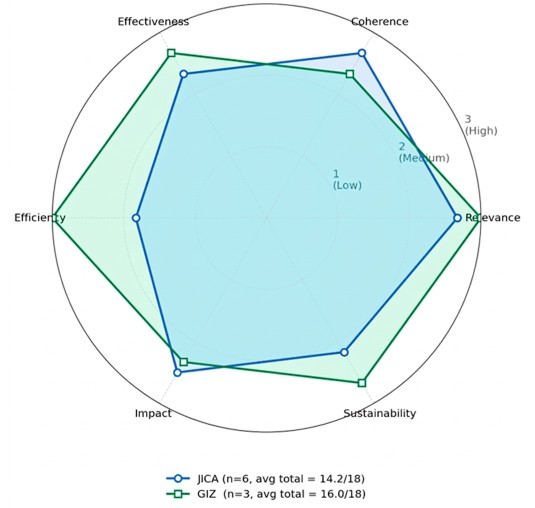
This study conducts a cross-case analysis of compost-related technical cooperation projects implemented by the Japan International Cooperation Agency (JICA) in Southeast Asia, applying the six OECD/DAC evaluation criteria (relevance, coherence, effectiveness, efficiency, impact, and sustainability). The analysis covers six projects in Indonesia, Malaysia, Thailand, and Vietnam. First, publicly available ex-post evaluation reports were analysed through close reading of report narratives and cited evidence. Second, semi-structured interviews with stakeholders were used to triangulate documentary evidence and validate interpretations of the evaluation results. The findings suggest that project performance and sustainability
are driven less by the technical sophistication of composting systems per se than by institutional fit and the design of local participation. As a comparative reference, the study also examines three cases under the Deutsche Gesellschaft für Internationale Zusammenarbeit (GIZ)’s ProSoil programme. The comparison indicates that GIZ’s strategic combination of standardised ‘ready-made’ equipment and a long-term programme framework contributed to higher scores on efficiency and sustainability, whereas selected JICA projects demonstrated relative strengths in contextual adaptation and community
engagement. Overall, the results imply that effective compost technology cooperation requires project designs that explicitly integrate institutional conditions and an appropriate support horizon, in addition to technical content.
References
Aziz, R., Chevakidagarn, P., & Danteravanich, S. (2018). Composting System Improvement by Life Cycle Assessment Approach on Community Composting of Agricultural and Agro-Industrial Wastes. Indonesian Journal of Environmental Management and Sustainability, 2(3), 69–75.
Dan, T. H., Liem, L. T. T., Lua, N. T. B., & Mi, L. T. D. (2023). Evaluation of Domestic Solid Waste Management in Cai Rang District, Can Tho City, Vietnam. Indonesian Journal of Environmental Management and Sustainability, 7(4), 128–136.
Deutsche Gesellschaft für Internationale Zusammenarbeit (GIZ) GmbH. (2025). Soil First: Advancing Food System Transformation Through Sustainable Soil Management.
Fitriani, A., Windusari, Y., & Putri, W. A. E. (2024). Community-Based Waste Management in the Township PT. Bukit Asam, Tanjung Enim, Indonesia. Indonesian Journal of Environmental Management and Sustainability, 8(2), 71–81.
Food and Agriculture Organization of the United Nations (FAO). (2011). Global Food Losses and Food Waste: Extent, Causes and Prevention. FAO.
Granovetter, M. (1985). Economic Action and Social Structure: The Problem of Embeddedness. American Journal of Sociology, 91(3), 481–510.
Hoornweg, D., & Bhada-Tata, P. (2012). What a Waste: A Global Review of Solid Waste Management.
Japan International Cooperation Agency (JICA). (2023). JICA Project Evaluation Guidelines (In Japanese).
Kawai, K., Liu, C., & Premakumara, J. D. G. (2020). CCET Guidelines for Municipal Solid Waste Management and Composting. United Nations Environment Programme & Institute for Global Environmental Strategies.
Kawai, K., Tasaki, T., & Somura, H. (2017). Assessing the Costs and Benefits of Waste Management in Developing Asian Countries. Waste Management, 69, 592–608.
Mikami, M. (2022). Managing ODA Evaluation: Organisations and Documents. Doshisha Seisaku Kagaku Kenkyu, 24(1), 11–20 (In Japanese).
Organisation for Economic Co-operation and Development (OECD). (2019). Better Criteria for Better Evaluation: Revised Evaluation Criteria Definitions and Principles for Use.
Organisation for Economic Co-operation and Development (OECD). (2021). Applying Evaluation Criteria Thoughtfully. OECD Publishing.
Premakumara, D. G. J., & Abe, M. (2015). Policies and Institutional Arrangements on Solid Waste Management in Asia. In D. Hoornweg, M. Bhada-Tata, & C. Kennedy (Eds.), Going Green: How Cities Are Leading the Next Economy. World Bank.
Schumacher, E. F. (1973). Small Is Beautiful: Economics as If People Mattered. Blond and Briggs.
Tanaka, N. (2017). Contemporary Significance and Creativity of Appropriate Technology. Kokusai Kaihatsu Kenkyu, 26(2), 7–18 (In Japanese).
United Nations Industrial Development Organization (UNIDO). (1978). Appropriate Technology and Industrial Development. Report.
Wilson, D. C., Rodic, L., Modak, P., Soos, R., Rogero, A. C., Velis, C., Iyer, M., & Simonett, O. (2015). Global Waste Management Outlook. United Nations Environment Programme.
Zurbrugg, C., Caniato, M., & Vaccari, M. (2014). How Assessment Methods Can Support Solid Waste Management in Developing Countries: A Systematic Literature Review. Sustainability, 6(2), 545–570.