
Corporate Social Responsibility and Climate Action: Assessing Indonesian Mining Companies’ Contributions to SDG 13
Article Sidebar
-
Environmental Governance, Sustainability Reporting, Resilience, Accountability, Stakeholder Engagement
Abstract
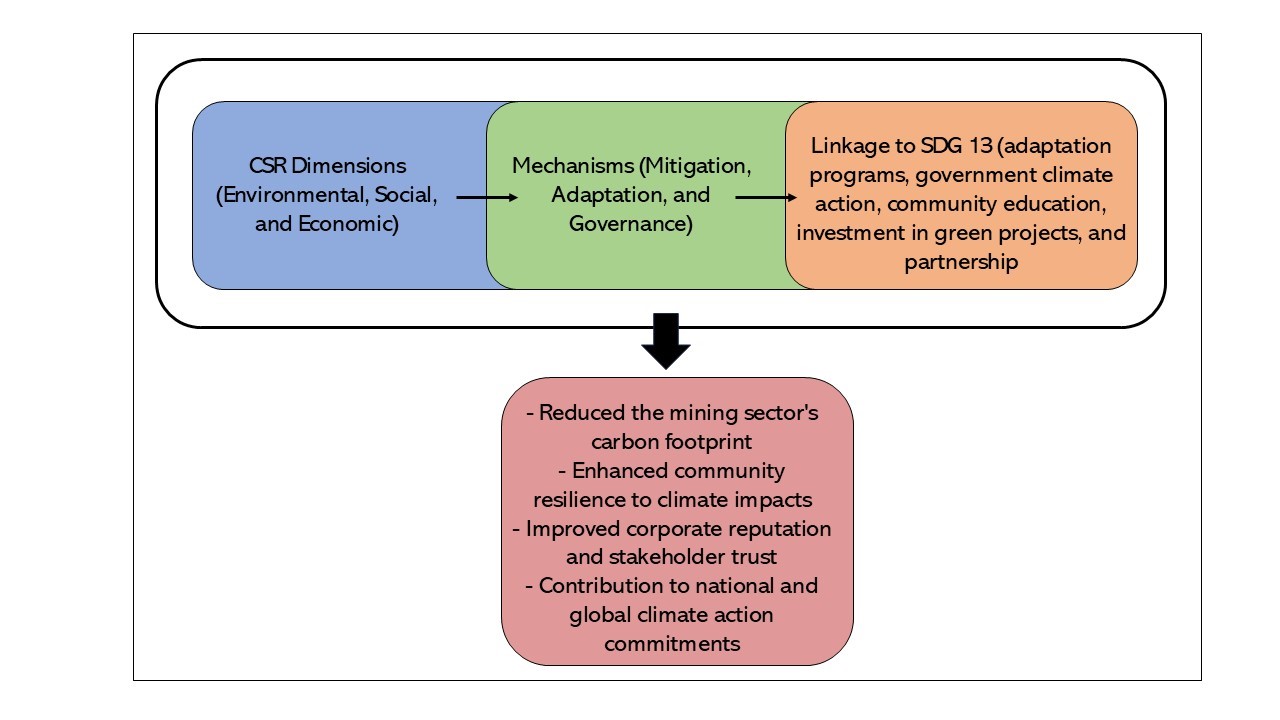
This study examines how Indonesian mining companies incorporate climate action within their corporate social responsibility (CSR) strategies, with a particular focus on their contributions to Sustainable Development Goal (SDG) 13. Using qualitative content analysis of ten publicly available CSR and sustainability reports, the study identifies recurring themes in corporate disclosures, including operational activities, environmental performance data, target-setting, and collaborative initiatives. The findings reveal both progress and gaps in aligning mining practices with national and international climate objectives. Four thematic areas emerge, including (1) operational decarbonization efforts that increasingly combine low-carbon technologies with nature-based solutions (NbS), although their effectiveness is rarely assessed through standardized indicators; (2) responsibility framing and measurable targets that show greater alignment with frameworks such as the Paris Agreement and Indonesia’s Nationally Determined Contributions, yet governance and assurance mechanisms remain underdeveloped, raising concerns of potential greenwashing; (3) while disclosure of environmental data has improved, comparability across firms is constrained by inconsistent adoption of metrics and limited integration of Life Cycle Assessment (LCA); and (4) climate-related risks are widely acknowledged, with firms outlining resilience strategies and engaging in multi-stakeholder partnerships to enhance adaptive capacity. Overall, Indonesian mining companies demonstrate a growing recognition of their role in climate action. However, advancing their contribution to SDG 13 requires systematic evaluation of NbS, stronger ESG governance and accountability, broader institutionalization of LCA, and deeper stakeholder engagement. These improvements are essential to ensure CSR initiatives deliver substantive, measurable, and socially inclusive climate outcomes.
References
Anggusti, M. and F. Y. D. Siregar (2024). Integration of Corporate Social Responsibility in Achieving Sustainable Development Goals (SDGs) in Indonesia. SASI, 30(1); X–XX. Faculty of Law Universitas Pattimura
Asih, A. S., A. Zamroni, W. Alwi, S. T. Sagala, and A. S. Putra (2022). Assessment of Heavy Metal Concentrations in Seawater in the Coastal Areas around Daerah Istimewa Yogyakarta Province, Indonesia. The Iraqi Geological Journal, 55(1B); 14–22
Azzahra, F., H. D. Fridayani, Y. Isnadi, and L. C. Chiang (2025). Addressing Climate Change in Indonesia: How Far Are Governments and Communities Acting Toward a Sustainable Environment? In IOP Conference Series: Earth and Environmental Science, volume 1475. IOP Publishing, page 012014
Del Rio, J. I., P. Fernandez, E. Castillo, and L. F. Orellana (2023). Assessing Climate Change Risk in the Mining Industry: A Case Study in the Copper Industry in the Antofagasta Region, Chile. Commodities, 2(3); 246–260
Di Febo, E. (2025). Transition Risk in Climate Change: A Literature Review. Risks, 13(4); 66
Fallah Shayan, N., N. Mohabbati-Kalejahi, S. Alavi, and M. A. Zahed (2022). Sustainable Development Goals (SDGs) As a Framework for Corporate Social Responsibility (CSR). Sustainability, 14(3); 1222
Fünfgeld, A. (2020). Coal vs Climate: Indonesia’s Energy Policy Contradicts Its Climate Goals. Technical Report 2, Hamburg
González-Rodríguez, M. R., M. C. Díaz-Fernández, and B. Simonetti (2015). The Social, Economic and Environmental Dimensions of Corporate Social Responsibility: The Role Played by Consumers and Potential Entrepreneurs. International Business Review, 24(5); 836–848
Gusman, I., P. Triatmojo, P. Rostiarti, and B. Arifiyanto (2018). Energy Efficiency and Greenhouse Gas Emissions Reduction Through Electrification Program at Tanjung Enim Mine Business Unit of PT Bukit Asam (Persero) Tbk. Indonesian Journal of Environmental Management and Sustainability, 2(1); 7–10
Hasan, H. M., F. Sanyal, D. Chaki, and M. H. Ali (2017). An Empirical Study of Important Keyword Extraction Techniques from Documents. In Proceedings of the 1st International Conference on Intelligent Systems and Information Management (ICISIM). IEEE, pages 91–94
IUCN French Committee (2019). Nature-Based Solutions for Climate Change Adaptation and Disaster Risk Reduction
Ivic, A. (2020). Trends in the Sustainability Reporting: A Case Study of European Mining Industry. Doctoral dissertation, University of Zagreb
Janikowska, O. and J. Kulczycka (2021). Impact of Minerals Policy on Sustainable Development of the Mining Sector: A Comparative Assessment of Selected EU Countries. Mineral Economics, 34(2); 305–314
Jia, M., J. Wang, Y. Li, Y. Zhang, T. Gao, and D. Wu (2024). Ecological Restoration of Mines Based on Nature Based Solutions: A Review. Coal Science and Technology, 52(8); 209–221
Kouhi, R. M., M. M. J. Moghaddam, S. F. Rafie, S. Maghsoudy, F. D. Ardejani, C. Butscher, and R. Taherdangkoo (2024). A Quantitative Framework for Measuring Sustainable Development Goals in Mining Operations. Discover Sustainability, 5(1); 1–18
Krippendorff, K. (2018). Content Analysis: An Introduction to Its Methodology. SAGE Publications, 4th edition
Kurniawan, H., I. Iskandar, and M. A. B. Sidik (2024). Power Sector Under Climate Scenario: A Study of Climate Policy Impact on Indonesia Electricity System. Indonesian Journal of Environmental Management and Sustainability, 8(2); 50–62
López-Vázquez, B. and C. Rangel-Pérez (2024). Strategies in the Luxury Fashion Industry Integrating the Circular Economy to Impact SDG12 and SDG13. In Textile Industry and the SDGs: Exploring Synergies for a Better Future. Springer Nature Singapore, Singapore, pages 109–125
Maskun, Achmad, Naswar, H. Assidiq, and S. N. Bachril (2021). Conflict of Norms in Indonesia’s Sustainable Development Policy: Mineral and Coal Mining Sector. In IOP Conference Series: Earth and Environmental Science, volume 724. page 012089
Matikainen, L. M. (2020). Enhancing Sustainability in the Mining Industry Through Stakeholder Engagement. Unpublished master’s thesis, Tampere University
Megawati, L. R. and A. Pratama (2024). Sustainable Development Goals in Corporate Reporting: Analysis of Economic, Social, and Environmental Disclosure (Survey Among Public Listed Companies in Indonesia). International Journal of Energy Economics and Policy, 14(3); 625–638
Mohammed, A. (2023). Mitigating Greenwashing: The Role of Audit Committees and Internal Audits in ESG Reporting Assurance. Ph.D. thesis, Durham University
Mukherjee, K. and P. Hridhya (2024). Impact of Carbon Accounting on Mitigating Greenwashing. Shanlax International Journal of Arts, Science and Humanities, 11; 156–166
Mursitama, T. N., A. Rahmasari, and E. Lusia (2025). Mapping and Achievement of Sustainable Development Goals in Indonesia’s High-Tech Industries: A Tale of Two Industries. International Journal of Sustainable Development and Planning, 20(3); 1167
Muskanan, M. W., C. Tilt, K. Rao, and R. Whait (2025). Contributing to Indonesia’s SDG Achievement: Disclosures of Regional-Owned Enterprises. Journal of Public Budgeting, Accounting and Financial Management, 37(2); 273–295
Nguyen-Trung, K. (2025). ChatGPT in Thematic Analysis: Can AI Become a Research Assistant in Qualitative Research? Quality & Quantity, 59; 4945–4978
Northey, S. A. (2018). Assessing Water Risks in the Mining Industry Using Life Cycle Assessment-Based Approaches. Doctoral dissertation, Monash University
Odell, S. D., A. Bebbington, and K. E. Frey (2018). Mining and Climate Change: A Review and Framework for Analysis. The Extractive Industries and Society, 5(1); 201–214
Pons, A., C. Vintró, J. Rius, and J. Vilaplana (2021). Impact of Corporate Social Responsibility in Mining Industries. Resources Policy, 72; 102117
Ptichnikov, A. V. and E. A. Shvarts (2023). Decarbonization via Nature-Based Solutions: National Policy and International Practice. Regional Research of Russia, 13(4); 631–645
Roeder, R. and S. Utz (2025). From Diversity to Confusion? The Challenge of Biodiversity Footprint Quantification. Business Strategy and the Environment, 34; 5887–5990
Sharma, D. and P. Bhatnagar (2015). Corporate Social Responsibility of Mining Industries. International Journal of Law and Management, 57(5); 367–372
Sharma, S., R. K. Singh, R. Mishra, and N. Subramanian (2024). Developing Climate Neutrality Among Supply Chain Members in Metal and Mining Industry: Natural Resource-Based View Perspective. The International Journal of Logistics Management, 35(3); 804–832
Siahaan, J. R., G. Pagalung, E. B. Demmallino, A. Saleng, A. A. Sulaiman, and N. Nagu (2025). Reframing Sustainability in Post-Mining Landscapes: A Foundational Framework for Institutional and Behavioral Integration in Indonesia. Sustainability, 17(12); 5278
Song, X., J. B. Pettersen, K. B. Pedersen, and S. Røberg (2017). Comparative Life Cycle Assessment of Tailings Management and Energy Scenarios for a Copper Ore Mine: A Case Study in Northern Norway. Journal of Cleaner Production, 164; 892–904
Svobodova, K., J. Vojar, M. Yellishetty, and K. J. Molnarova (2020). A Multi-Component Approach to Conceptualizing the Reputation of the Mining Industry from a Stakeholder Perspective. Resources Policy, 68; 101724
United Nations (2015). Transforming Our World: The 2030 Agenda for Sustainable Development
Wahid, A. Y. and A. M. Magassing (2025). Establishing an Environmental Court in Indonesia: Addressing Legal Challenges for Environmental Justice in Line with SDG 13 and SDG 16. Journal of Lifestyle and SDGs Review, 5(1); e03043–e03043
Wang, H., L. Tong, R. Takeuchi, and G. George (2016). Corporate Social Responsibility: An Overview and New Research Directions. Academy of Management Journal, 59(2); 534–544
Zamroni, A., W. E. C. Putri, R. Nolos, and R. Ceballos (2025). Nature-Based Solutions for Agricultural Drought Adaptation Strategies in the Karst Area of Gunungkidul Regency, Indonesia. Southeastern Philippines Journal of Research and Development, 30(1); 131–152
Zamroni, A., W. E. C. Putri, and S. T. Sagala (2022). Evaluation of Corporate Social Responsibility Programs for Local Communities Around Mining Companies in Kalimantan, Indonesia: Environmental, Economic, and Social Perspectives. Sustinere: Journal of Environment and Sustainability, 6(1); 66–78